
Introduction
An AI model is one of the most important building blocks behind modern artificial intelligence.
When you use an AI chatbot, ask a voice assistant a question, receive a recommendation, or use an app that recognizes objects in a photo, an AI model may be working behind the scenes.
But what exactly is an AI model?
In simple terms, an AI model is a computational system that has been designed or trained to recognize patterns and perform particular tasks. Depending on its purpose, an AI model might classify information, make predictions, recognize images, understand language, or generate new content.
In this beginner-friendly guide, you will learn what an AI model is, how it works, how models are trained, and how they are used in everyday life.
If you are completely new to artificial intelligence, start with our guide: What Is AI? A Simple Guide for Beginners
What Is an AI Model?
An AI model is a mathematical or computational representation used by an artificial intelligence system to process information and produce an output.
Different models are built for different purposes.
For example, an AI model might be designed to:
- Identify objects in photographs
- Detect spam emails
- Recognize spoken words
- Recommend movies
- Predict numerical values
- Translate languages
- Generate text or images
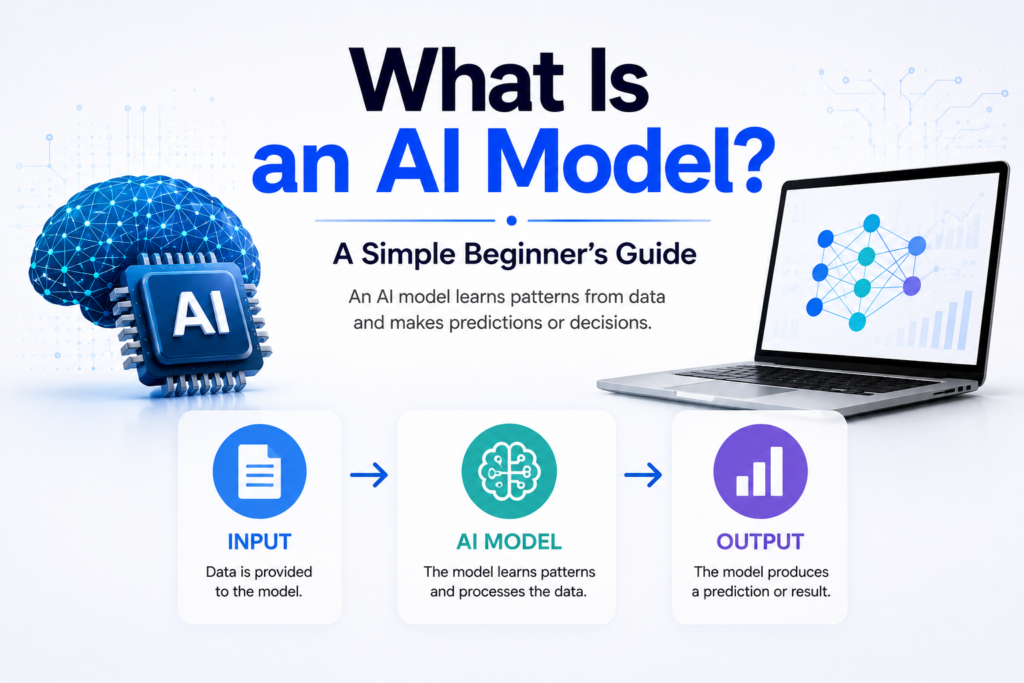
The model receives an input, processes it according to its learned parameters or programmed structure, and produces an output.
A simple way to think about it is:
Input → AI Model → Output
For example, you might provide an image as input. The AI model analyzes it and produces an output such as “cat” or “dog.”
How Does an AI Model Work?
The exact way an AI model works depends on the type of model and the task it was created to perform.
However, many modern machine learning models follow a general process.
1. The Model Receives Input
The first step is receiving information.
The input could be:
- Text
- Images
- Audio
- Video
- Numbers
- Other types of data
For an AI chatbot, the input might be a question typed by a user.
For an image-recognition system, the input might be a photograph.
2. The Model Processes the Information
The model then processes the input using its internal structure and parameters.
Modern AI models can contain large numbers of numerical parameters that influence how information is processed.
These parameters may be adjusted during training so the model becomes better at identifying useful patterns.
3. The Model Produces an Output
After processing the information, the model produces a result.
Depending on the application, the output might be:
- A prediction
- A classification
- A recommendation
- A translation
- An answer
- Generated content
The type of output depends on what the model was designed and trained to do.
How Is an AI Model Trained?
Many modern AI models become useful through a process called training.
During training, the model is given data and repeatedly adjusts its internal parameters to improve its performance.
A simplified training process looks like this:
- Give the model training data.
- Let the model produce a prediction or result.
- Compare the result with the desired outcome.
- Measure the error.
- Adjust the model’s parameters.
- Repeat the process.
Over time, the model can become better at identifying useful patterns.
For a complete explanation of this process, read: How Is AI Trained? A Simple Beginner’s Guide
What Are AI Model Parameters?
You may often hear the word “parameters” when people discuss AI models.
Parameters are numerical values within a model that influence how it processes information.
During machine learning training, these values can be adjusted based on data.
In a neural network, for example, weights and biases are important types of parameters.
Large modern AI models can contain enormous numbers of parameters.
However, having more parameters does not automatically mean that a model is better for every task. Model quality also depends on factors such as architecture, training data, training methods, evaluation, and how the model is used.
AI Models and Machine Learning
AI and machine learning are closely related, but they are not identical.
Artificial intelligence is the broader concept of creating systems that can perform tasks associated with intelligent behavior.
Machine learning is one approach used to build many AI systems.
A machine learning model learns patterns from data instead of relying only on manually written rules.
For example, rather than programming every possible visual characteristic of a cat, developers can train a machine learning model using many examples.
To understand this relationship more clearly, read: AI vs. Machine Learning: What’s the Difference?
AI Models and Neural Networks
A neural network is a particular type of model widely used in modern AI.
Neural networks contain connected processing units organized into layers.
During training, the network’s parameters are adjusted so that it can become better at a particular task.
Neural networks are used in areas such as:
- Image recognition
- Speech recognition
- Natural Language Processing
- Generative AI
- Large Language Models
For a beginner-friendly explanation, read: What Is a Neural Network? A Simple Beginner’s Guide
What Are Large Language Models?
Large Language Models, commonly called LLMs, are a type of AI model designed to process and generate language.
These models are trained on large amounts of data and learn statistical patterns and relationships within language.
When you provide a prompt, an LLM processes the available context and generates an output based on its learned parameters.
LLMs can be used for tasks such as:
- Answering questions
- Drafting text
- Summarizing information
- Explaining concepts
- Assisting with writing
- Working with multiple languages
For a more detailed explanation, read: What Are Large Language Models (LLMs)? A Simple Beginner’s Guide
Are All AI Models the Same?
No.
There are many different types of AI models, and they can differ greatly in size, design, training method, and purpose.
Some models are designed for one specific task.
Others can perform a wider range of tasks.
For example:
Classification Models
These models assign information to categories.
A spam filter might classify an email as:
- Spam
- Not spam
Prediction Models
Prediction models estimate an outcome based on available information.
For example, a model might predict future demand based on historical data.
Computer Vision Models
Computer Vision models work with visual information.
They can be used for tasks such as:
- Image classification
- Object detection
- Image segmentation
- Text recognition
To learn more about visual AI, read: What Is Computer Vision? A Simple Beginner’s Guide
Language Models
Language models work with text and language patterns.
They can help with translation, text generation, summarization, and conversational AI.
Generative AI Models
Generative models are designed to produce new content.
Depending on the model, they may generate:
- Text
- Images
- Audio
- Video
- Code
To understand this category, read: Generative AI Explained: A Beginner’s Guide
What Happens After an AI Model Is Trained?
Once a model has been trained, it can be used to process new information.
This stage is called inference.
During inference, the trained model receives new input and produces an output using the patterns and parameters established during training.
For example:
Training: A model learns patterns from many images.
Inference: The trained model receives a new image and predicts what it contains.
This distinction is important because training and using a model are different processes.
For a complete explanation, read: What Is AI Inference? A Simple Beginner’s Guide
Everyday Examples of AI Models
AI models are already used in many technologies people encounter regularly.
Email Spam Filters
An AI model can analyze incoming messages and estimate whether they are likely to be spam.
Recommendation Systems
Streaming platforms and online services can use models to recommend content based on available information and patterns.
Smartphone Cameras
AI models may help smartphones recognize scenes, improve images, or organize photographs.
Voice Assistants
Speech and language models can help voice assistants recognize spoken words and respond to requests.
Translation Tools
AI models can process language and generate translations.
AI Chatbots
AI chatbots use language models to process prompts and generate responses.
These examples show that an AI model is not necessarily a separate app or robot that you can see. Often, it is a component working behind the scenes inside a larger software system.
AI Model vs. AI Application
An AI model and an AI application are not necessarily the same thing.
The model is the computational component that processes information and produces outputs.
An application is the product or service that people interact with.
For example, an AI-powered application may include:
- A user interface
- One or more AI models
- Databases
- Security systems
- Other software components
This distinction helps explain why different applications can sometimes use the same or similar underlying models.
Can One Application Use Multiple AI Models?
Yes.
An AI application can use multiple models to perform different tasks.
For example, a system could use:
- A speech-recognition model to convert speech into text
- A language model to understand or generate a response
- Another model to generate speech from text
These models can work together as parts of a larger system.
This is one reason modern AI applications can perform increasingly complex tasks.
Are AI Models Always Accurate?
No.
AI models can make mistakes.
Their performance can be affected by:
- Training data quality
- Model design
- Training methods
- Input quality
- Situations that differ from training data
- Limitations of the model
A language model may generate incorrect information.
An image model may misidentify an object.
A recommendation model may suggest something irrelevant.
For important decisions, AI outputs should be evaluated appropriately rather than automatically assumed to be correct.
Does an AI Model Think Like a Human?
An AI model should not automatically be treated as a human mind.
Modern models can perform impressive tasks, but their underlying processes are different from human thinking and experience.
AI models operate through computational processes and learned mathematical patterns.
They do not automatically possess human:
- Consciousness
- Emotions
- Life experiences
- Judgment
- Common sense
Using human terms such as “learn” can make AI easier to explain, but it is important to remember that machine learning is a computational process.
Why Are There So Many Different AI Models?
Different tasks have different requirements.
A small model designed for one specialized task may be more practical than a very large general-purpose model.
Developers may consider factors such as:
- Accuracy
- Speed
- Cost
- Model size
- Available computing power
- Privacy
- Intended task
This is why there is no single AI model that is automatically best for every situation.
Why Should Beginners Understand AI Models?
Understanding AI models makes many other AI concepts easier to connect.
The basic process is:
Data → Training → AI Model → Inference → Output
Once you understand this sequence, you can more easily understand what happens behind many AI-powered tools.
You also begin to see the difference between:
- AI and an AI model
- Training and inference
- A model and an application
- Input data and generated output
For additional educational information, IBM’s AI Models overview explains how AI models work, how they are trained, and how different types of models are used.
Final Thoughts
An AI model is one of the core components that allows an artificial intelligence system to perform useful tasks.
Models can recognize patterns, classify information, make predictions, process language, analyze images, and generate new content.
Many modern models learn patterns through training and later use those learned patterns during inference.
The easiest relationship for beginners to remember is:
Data → Training → AI Model → New Input → Inference → Output
You do not need to understand all of the mathematics behind AI models to understand their basic role.
Once you understand what an AI model is, many other artificial intelligence concepts become much easier to follow.