
Introduction
AI Inference is the process that happens when a trained artificial intelligence model uses what it has learned to produce a result from new information.
For example, when you ask an AI chatbot a question and receive an answer, inference is taking place. When an AI system recognizes an object in a new photograph or predicts whether an email is spam, it is also performing inference.
This is different from AI training.
Training is the process of adjusting a model so it can learn useful patterns from data. Inference happens after training, when the trained model uses those patterns to process new inputs.
In this beginner-friendly guide, you will learn what AI Inference is, how it works, how it differs from AI training, and where you may encounter it in everyday life.
If you are new to artificial intelligence, start with our guide: What Is AI? A Simple Guide for Beginners
What Is AI Inference?
AI Inference is the process of using a trained AI model to make a prediction, classification, decision, or generated output based on new input.
The input could be:
- A question
- An image
- A voice recording
- A document
- Numerical data
- A video
The model processes that input using patterns learned during training and produces an output.
For example, imagine an AI model that has already been trained to recognize cats and dogs.
If you give the trained model a new photograph, it can analyze the image and predict whether it contains a cat or a dog.
That prediction is an example of inference.
AI Training vs. AI Inference
One of the easiest ways to understand AI Inference is to compare it with AI training.
AI Training
During training, a model:
- Processes training data
- Makes predictions
- Measures errors
- Adjusts internal parameters
- Repeats the process many times
The goal is to create a model that can perform a particular task effectively.
AI Inference
During inference, the trained model:
- Receives new input
- Processes the input using its learned parameters
- Produces an output
The model is using what it learned rather than being trained from scratch each time.
A simple way to remember the difference is:
Training = learning patterns
Inference = using learned patterns
For a complete beginner-friendly explanation of the training process, read: How Is AI Trained? A Simple Beginner’s Guide
How Does AI Inference Work?
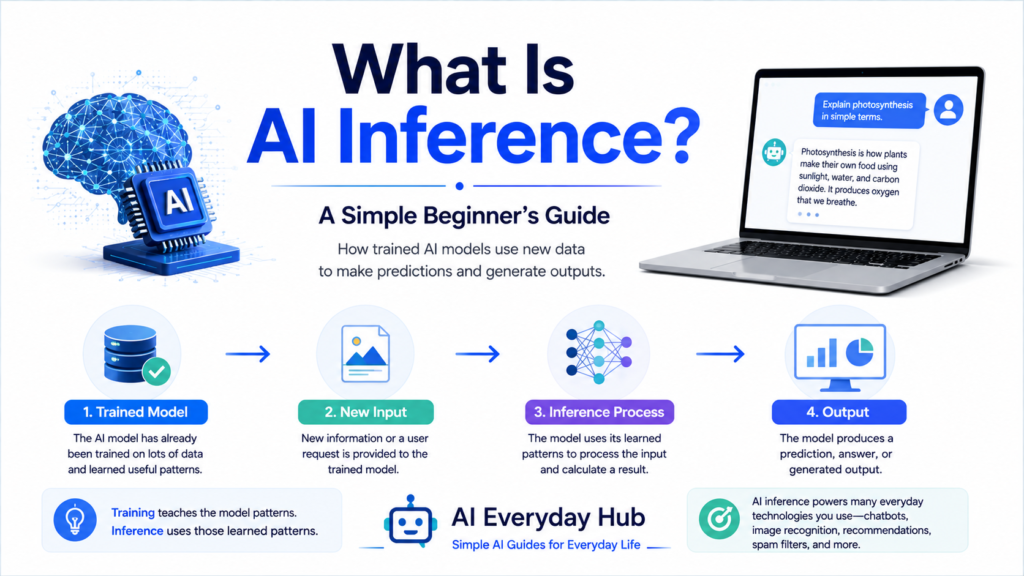
The exact process depends on the AI model, but a simplified inference process can be understood in four steps.
1. The Model Receives New Input
First, the trained model receives information.
For example:
- A user types a question into an AI chatbot.
- A camera captures an image.
- A person speaks into a voice assistant.
- A recommendation system receives information about user activity.
This new information becomes the input.
2. The Model Processes the Input
Next, the AI model processes the input using the parameters learned during training.
In a neural network, information moves through layers of connected computational units.
Each layer performs mathematical operations that help transform the input into a useful representation.
To understand the basic technology behind this process, read: What Is a Neural Network? A Simple Beginner’s Guide
3. The Model Calculates a Result
The model then calculates an output based on the patterns it learned.
Depending on the application, it might:
- Assign probabilities to possible categories
- Predict a numerical value
- Generate text
- Identify an object
- Recommend an item
The exact result depends on the task the model was designed to perform.
4. The System Produces the Output
Finally, the result is presented or used by another part of the system.
For example:
- A chatbot displays a response.
- A photo application identifies an object.
- A translation service displays translated text.
- A recommendation system suggests a video.
From the user’s perspective, this can happen very quickly.
A Simple Example of AI Inference
Imagine that an AI model has been trained to recognize handwritten numbers.
During training, the model analyzed many examples of numbers from 0 through 9.
Now you give it a new image containing a handwritten number 7.
The trained model processes the image and calculates which number is most likely represented.
It might determine:
- 7: 96%
- 1: 2%
- 9: 1%
- Other numbers: 1%
The system then returns “7” as its prediction.
The model is not being trained on that image from the beginning.
It is using previously learned patterns to make a prediction.
That is AI Inference.
Everyday Examples of AI Inference
AI Inference occurs in many technologies people use regularly.
AI Chatbots
When you type a prompt into an AI chatbot, the trained language model processes your input and generates a response.
The model uses its learned parameters to predict and generate appropriate sequences of text.
This is inference happening while you interact with the system.
Image Recognition
When an AI-powered application analyzes a new photograph and identifies objects within it, the trained model is performing inference.
Computer Vision systems can use inference for tasks such as:
- Image classification
- Object detection
- Face detection
- Text recognition
To learn how AI works with visual information, read: What Is Computer Vision? A Simple Beginner’s Guide
Voice Assistants
When you speak to a voice assistant, AI models can help process your speech and determine what you are asking.
Different models may perform inference at different stages, such as speech recognition and language processing.
Recommendation Systems
Streaming services, online stores, and other platforms can use trained models to predict what content or products may interest a user.
When the system uses current information to produce a recommendation, inference may be part of that process.
Spam Detection
An email service may use a trained model to analyze a new incoming message.
The model can evaluate patterns in the message and estimate whether it is likely to be spam.
That classification is another example of inference.
AI Inference and Large Language Models
Large Language Models, or LLMs, provide a useful example of AI Inference.
An LLM is trained on large amounts of data before users interact with it.
After training, a user can provide a prompt.
The model processes the prompt and generates an output by calculating likely sequences of tokens based on its learned parameters and the available context.
This generation process is inference.
For example, you might ask:
“Explain photosynthesis in simple terms.”
The trained language model processes the prompt and generates a response.
It is not retraining the entire model every time you ask a question.
For more information about these models, read: What Are Large Language Models (LLMs)? A Simple Beginner’s Guide
AI Inference and Deep Learning
Many modern AI systems use deep learning models.
These models can contain many layers and large numbers of parameters.
During inference, new data moves through the trained network to produce an output.
For example, a deep learning model might use inference to:
- Recognize an object in a photograph
- Transcribe speech
- Analyze text
- Generate content
The complexity of the model can affect how much computing power is required for inference.
To understand deep learning in simple terms, read: What Is Deep Learning? A Simple Beginner’s Guide
Where Does AI Inference Happen?
AI Inference can happen in different places depending on the application.
In the Cloud
Many AI services run models on powerful computers in data centers.
Your device sends a request to the service, the model processes it, and the result is returned.
Cloud inference can provide access to large and powerful models.
On Your Device
Some AI models can run directly on devices such as:
- Smartphones
- Laptops
- Cameras
- Vehicles
- Smart devices
This is sometimes called on-device or edge inference.
Running models closer to where data is generated can offer advantages in areas such as response time, connectivity, and privacy, depending on the application.
Why Is Inference Speed Important?
People often expect AI applications to respond quickly.
Imagine waiting a long time every time you:
- Asked a chatbot a question
- Unlocked a device using facial recognition
- Used voice commands
- Requested a translation
Slow inference can make an AI application frustrating or impractical.
Developers therefore work to improve inference performance so models can produce useful results efficiently.
Does AI Learn During Every Inference?
Not necessarily.
A common misconception is that an AI model automatically learns and permanently changes every time someone uses it.
In standard inference, the model generally uses parameters that were established during training.
A user’s individual request does not necessarily retrain the underlying model.
Some AI systems may collect feedback or data that can later be used in separate training or improvement processes, but that is different from saying that the model retrains itself after every interaction.
This distinction is important for understanding how modern AI services work.
Can AI Inference Be Wrong?
Yes.
A trained model can still produce incorrect results during inference.
For example:
- An image-recognition model can misidentify an object.
- A spam filter can incorrectly classify an email.
- A language model can generate inaccurate information.
- A recommendation system can suggest irrelevant content.
The quality of inference depends on many factors, including:
- Training data
- Model design
- Input quality
- The situation in which the model is used
- Model limitations
This is why important AI-generated information should be reviewed rather than automatically assumed to be correct.
Training Cost vs. Inference Cost
Training and inference both require computing resources, but in different ways.
Training a large AI model can require enormous computing power because the model’s parameters must be adjusted repeatedly across large amounts of data.
Inference usually does not involve repeating that entire training process.
However, inference can still require substantial computing resources, especially when large models serve millions of user requests.
For companies operating AI services at scale, making inference faster and more efficient can therefore be very important.
Why Should Beginners Understand AI Inference?
Understanding AI Inference helps connect many of the AI concepts you have already learned.
It explains what happens after an AI model has been trained.
The basic relationship is:
Training Data → AI Training → Trained Model → New Input → AI Inference → Output
Once you understand this sequence, many everyday AI applications become easier to understand.
You can see the difference between:
- Teaching a model and using a model
- Training data and new input
- Model learning and model prediction
For additional technical background, IBM’s AI Inference overview explains how trained AI models use new data to generate predictions and outputs.
Final Thoughts
AI Inference is the process of using a trained AI model to produce a result from new information.
It happens when an AI chatbot responds to a prompt, an image-recognition system identifies an object, a recommendation system suggests content, or a spam filter analyzes a new email.
The easiest way to remember the concept is:
Training teaches the model patterns. Inference uses those learned patterns.
You do not need to understand advanced mathematics to understand this important distinction.
Knowing the difference between AI training and AI Inference gives you a clearer picture of what happens behind the scenes whenever you use a modern AI system.