
Introduction
How is AI trained to recognize images, understand language, answer questions, and make predictions?
Modern artificial intelligence may seem intelligent when it responds to a question or identifies an object in a photograph, but an AI model does not simply begin with these abilities.
In many modern AI systems, training is the process of using data and mathematical methods to adjust a model so it becomes better at performing a particular task.
During training, the model processes examples, makes predictions, measures errors, and adjusts internal parameters. This process may be repeated many times until the model reaches an acceptable level of performance.
This beginner-friendly guide answers the question “How is AI trained?” and explains why training data matters, how models improve during training, and what happens after training is complete.
If you are completely new to artificial intelligence, start with our guide: What Is AI? A Simple Guide for Beginners
What Does It Mean to Train AI?
To understand how AI is trained, it helps to know that training generally means teaching a machine learning model to identify useful patterns in data.
Consider a simple example.
Imagine that you want to build an AI system that can recognize pictures of cats and dogs.
You could provide the system with many example images. During training, the model analyzes patterns in those images and adjusts its internal parameters to improve its predictions.
Eventually, when shown a new image it has never seen before, the goal is for the model to correctly determine whether the image contains a cat or a dog.
This ability to work with new information is an important goal of machine learning.
How Is AI Trained?
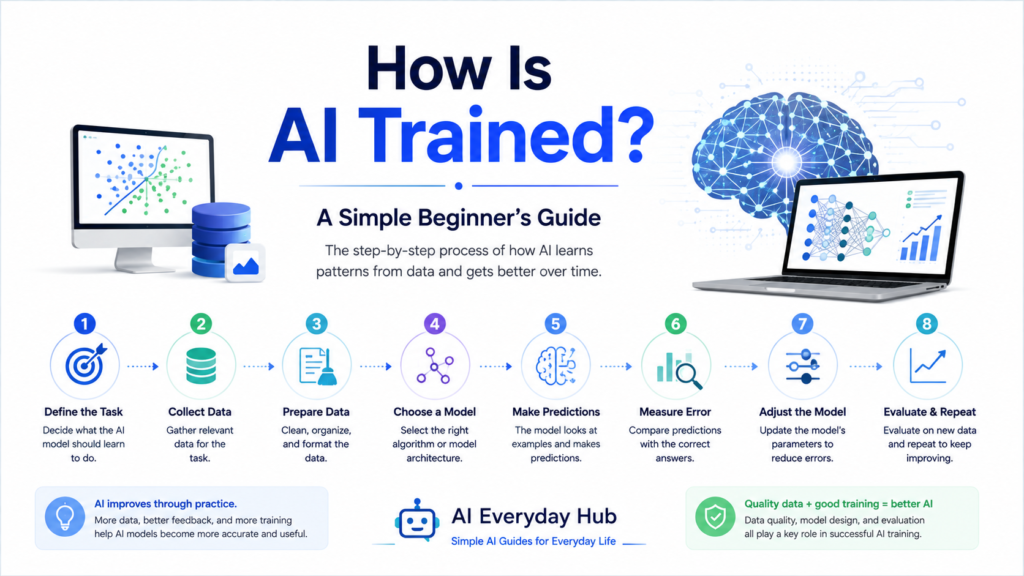
The exact training process varies depending on the model and task, but a simplified process can be understood in several steps.
1. Define the Task
Before training begins, developers need to determine what they want the AI model to do.
For example, the goal might be to:
- Recognize objects in images
- Detect spam emails
- Predict numerical values
- Understand language patterns
- Generate text
- Recommend content
Different tasks may require different models, data, and training methods.
2. Collect Training Data
Next, the model needs data from which it can learn patterns.
Training data might include:
- Text
- Images
- Audio
- Video
- Numbers
- Other structured or unstructured information
The type of data depends on the task.
For example, an image-recognition model needs visual data, while a language model needs text or other language-related data.
The quality and relevance of training data can strongly influence how useful the final model becomes.
3. Prepare the Data
Raw data is not always ready for training.
Depending on the application, data may need to be:
- Organized
- Cleaned
- Labeled
- Converted into a suitable format
- Checked for errors or duplicates
Data preparation can be an important part of developing a useful AI system.
4. Choose a Model
Developers then choose an appropriate machine learning algorithm or model architecture.
Different types of models are suited to different problems.
Neural networks, for example, are widely used in modern AI applications involving images, language, speech, and other complex data.
To understand how these models work, read: What Is a Neural Network? A Simple Beginner’s Guide
5. Let the Model Make Predictions
During training, the model receives examples from the training data and produces outputs.
At the beginning, those outputs may be inaccurate because the model’s parameters have not yet been properly adjusted.
For example, an image model might incorrectly identify a dog as a cat.
The training process needs a way to measure this error.
6. Measure the Error
The model’s prediction can be compared with the expected result.
A mathematical function commonly called a loss function measures how far the model’s prediction is from the desired result.
A larger error generally indicates that the model needs greater adjustment.
This gives the training system information that can be used to improve the model.
7. Adjust the Model
The training algorithm then adjusts the model’s internal parameters.
In neural networks, these parameters include numerical values commonly called weights and biases.
The objective is to adjust these values so that future predictions become more accurate.
This process of making predictions, measuring errors, and adjusting parameters is repeated over many training iterations.
IBM describes model training as an iterative process in which parameters are optimized using training data and performance is evaluated as the model improves.
8. Evaluate the Model
Performing well on training examples is not enough.
A useful model should also perform well on data it did not simply memorize during training.
Developers therefore evaluate models using separate data to determine whether they can generalize to new examples.
If a model performs extremely well on its training data but poorly on new data, it may be experiencing a problem called overfitting.
A Simple Example of AI Training
Imagine teaching an AI model to recognize apples.
The training dataset contains thousands of images, including examples labeled as apples and examples of other objects.
The model processes these images and begins identifying useful visual patterns.
Its first predictions may be poor.
After comparing predictions with the correct answers, the training process adjusts the model.
This happens repeatedly.
Eventually, the model may become much better at recognizing apples in new photographs.
The important point is that the model was not given a simple rule such as:
“Every apple looks exactly like this.”
Instead, machine learning allows the model to learn useful statistical patterns from examples.
What Is Training Data?
Training data is the information used during the learning process.
For different AI systems, training data can look very different.
A Computer Vision system might learn from images.
A speech-recognition model might learn from audio.
A language model might learn patterns from large collections of text.
A recommendation system might use information related to interactions, preferences, or behavior.
Training data is important because the patterns contained in that data influence what the model learns.
For an example of how AI works with visual training data, read: What Is Computer Vision? A Simple Beginner’s Guide
What Are the Main Types of Machine Learning?
Not every AI system learns in exactly the same way.
Three commonly discussed machine learning approaches are supervised learning, unsupervised learning, and reinforcement learning.
Supervised Learning
Supervised learning uses labeled examples.
For instance, an image may be labeled:
“Cat”
or:
“Dog”
The model uses these examples to learn relationships between inputs and the expected outputs.
IBM describes supervised learning as using labeled datasets to train models to identify patterns and make predictions on new data.
Unsupervised Learning
Unsupervised learning works with data without the same kind of predefined answer labels.
The system attempts to identify patterns, structures, or groups within the data.
For example, a system might identify groups of similar customers based on behavioral patterns.
Reinforcement Learning
Reinforcement learning involves learning through interactions and feedback.
An AI system takes actions and receives rewards or penalties based on the results.
Over time, the system attempts to learn strategies that increase its overall reward.
How Are Neural Networks Trained?
Neural networks are especially important in modern AI.
A neural network contains connected processing units arranged in layers.
During training, data moves through the network and produces an output.
The output is compared with the desired result, and the network’s parameters are adjusted to reduce errors.
This process may be repeated across large numbers of examples.
Deep learning uses neural networks with multiple processing layers, making it possible to learn highly complex patterns.
For a more detailed explanation, read: What Is Deep Learning? A Simple Beginner’s Guide
How Are Large Language Models Trained?
Large Language Models, or LLMs, are advanced neural-network models designed to work with language.
During pretraining, an LLM processes enormous amounts of text and learns statistical relationships and patterns in language.
A common training objective involves predicting tokens based on surrounding or preceding context.
Through this process, the model adjusts a very large number of parameters.
Additional training stages can then be used to refine model behavior for particular purposes.
For a beginner-friendly explanation of these models, read: What Are Large Language Models (LLMs)? A Simple Beginner’s Guide
Training AI Is Different From Using AI
Training and using an AI model are different stages.
Training is the process in which the model’s parameters are adjusted based on data.
After training, the model can be used to process new inputs and generate predictions or outputs.
Using a trained model to produce an output is often called inference.
For example, when you ask a trained AI chatbot a question, the model generally does not retrain itself from scratch on your question.
Instead, it uses its existing trained parameters to process your input and generate a response.
Does AI Memorize Everything It Learns?
AI training should not be thought of as simply storing a giant database of answers.
Machine learning models learn numerical patterns and relationships from training data.
However, models can sometimes reproduce or closely resemble information encountered during training, and memorization can occur under certain circumstances.
This is one reason model developers need to consider training methods, data quality, privacy, evaluation, and safeguards.
The goal of a useful model is generally to learn patterns that help it perform well on new situations rather than simply memorize its training examples.
Why Does Training AI Require So Much Computing Power?
Training advanced AI models can require substantial computing resources.
Large neural networks may contain millions or billions of adjustable parameters.
During training, computers repeatedly perform mathematical calculations to update these parameters.
Large-scale AI training can therefore require:
- Powerful processors
- Large amounts of memory
- Data storage
- Electricity
- Significant training time
The amount of computing power required depends greatly on the size and complexity of the model.
Why Does Training Data Quality Matter?
More data does not automatically mean better AI.
The quality of the data matters as well.
Training data can contain:
- Errors
- Missing information
- Duplicates
- Outdated information
- Unbalanced examples
- Unwanted biases
These problems can influence the model’s performance.
Developers therefore need to carefully collect, prepare, evaluate, and manage training data.
Can AI Make Mistakes After Training?
Yes.
Training does not make an AI model perfect.
A trained model can still:
- Misclassify information
- Misunderstand unusual inputs
- Produce inaccurate predictions
- Generate incorrect information
- Perform poorly in situations different from its training data
This is why testing, evaluation, monitoring, and human oversight can remain important even after training is complete.
Why Should Beginners Understand AI Training?
Understanding the basic training process makes many other AI concepts easier to understand.
It helps explain:
- Why AI needs data
- How machine learning differs from traditional programming
- Why neural networks improve during training
- Why AI can make mistakes
- Why training data matters
- Why large AI models require substantial computing resources
You do not need to understand the mathematics behind every training algorithm.
The most important idea is simple:
AI training is a process of adjusting a model so it becomes better at identifying useful patterns and performing its intended task.
For a deeper explanation of the complete process, IBM’s Model Training overview explains training data, model parameters, optimization, validation, and evaluation.
Final Thoughts
AI systems do not automatically know how to recognize images, understand language, or make useful predictions.
Understanding how AI is trained makes it easier to see how many modern AI capabilities are developed.
During training, a model processes examples, produces outputs, measures errors, and adjusts internal parameters to improve its performance.
Training data, model design, computing resources, and evaluation all influence the final result.
Once you understand this basic process, concepts such as machine learning, neural networks, deep learning, Computer Vision, and Large Language Models become much easier to connect.
AI training may involve complex mathematics behind the scenes, but the beginner-level concept is straightforward:
Give a model relevant data, evaluate its results, adjust it, and repeat the process so it can become better at its task.