
Introduction
Deep learning is one of the most important technologies behind modern artificial intelligence.
You may have heard about deep learning when reading about AI tools, image recognition, voice assistants, or generative AI. However, many beginners are still unsure about what deep learning actually means.
Is it the same as artificial intelligence? Is it different from machine learning? Why is it so important for today’s AI technology?
In simple terms, deep learning is a type of machine learning that allows computers to learn complex patterns from large amounts of data using artificial neural networks.
This guide explains what deep learning is, how it works, and how it is used in everyday technology.
If you are new to artificial intelligence, start with our beginner guide: What Is AI? A Simple Guide for Beginners
What Is Deep Learning?
Deep learning is an advanced type of machine learning that uses artificial neural networks to learn patterns from data.
Neural networks are computer systems designed to process information through connected layers. The basic idea was inspired in part by biological neural networks, but artificial neural networks do not work exactly like the human brain.
Deep learning models can analyze large amounts of information and identify patterns that help them perform specific tasks.
Examples include:
- Recognizing objects and faces in images
- Understanding spoken language
- Translating languages
- Generating text and images
- Finding patterns in large amounts of data
Unlike simpler systems that depend heavily on manually written rules, deep learning models can learn useful patterns during training.
How Does Deep Learning Work?
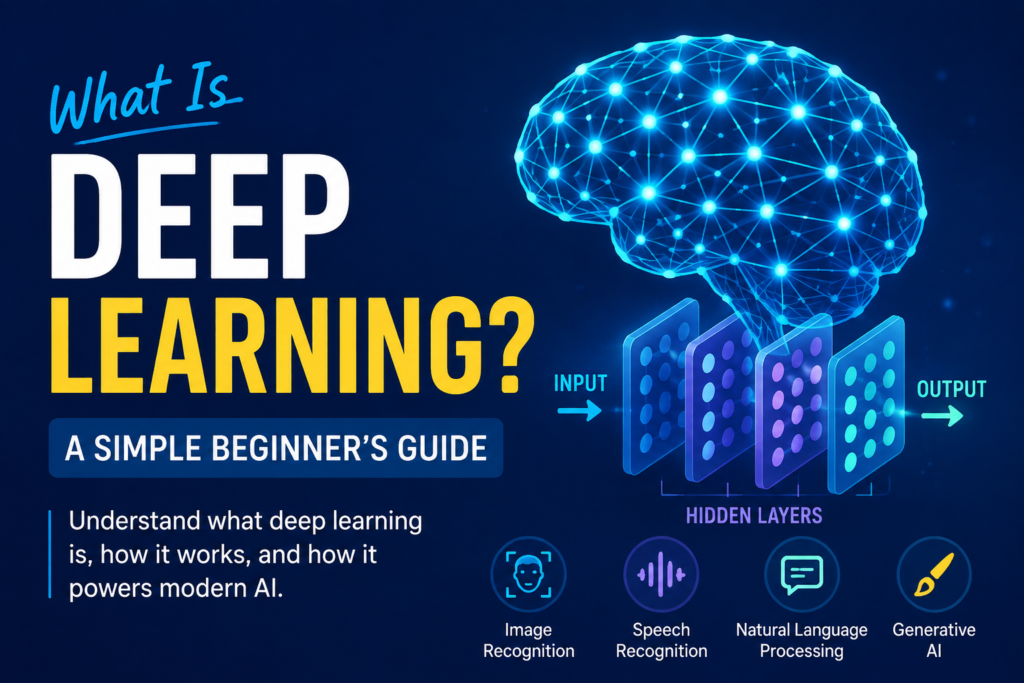
Deep learning works through artificial neural networks made up of multiple layers.
Each layer processes information and passes the results to the next layer. As information moves through the network, the model can learn increasingly complex patterns.
Here is a simple way to understand the process.
1. Input Layer
The input layer receives information.
The input might be:
- An image
- A sentence
- A voice recording
- Numerical data
For example, if the system is learning to recognize an animal in a photograph, the image becomes the input.
2. Hidden Layers
The hidden layers analyze patterns within the information.
In a simplified image-recognition example, earlier layers might detect basic features such as edges, shapes, or textures. Later layers can combine those features into more complex patterns.
A deep neural network may contain many processing layers, which is where the term “deep” comes from.
3. Output Layer
The output layer produces the model’s result.
Depending on the task, the result might be:
- Identifying an object
- Classifying information
- Predicting an outcome
- Generating text
- Producing other types of content
During training, the model adjusts its internal parameters to improve its results.
Deep Learning vs. Machine Learning
Many beginners confuse deep learning with machine learning.
The easiest way to understand the relationship is:
Artificial Intelligence (AI) → Machine Learning → Deep Learning
Artificial intelligence is the broadest concept.
Machine learning is an approach that enables computer systems to learn patterns from data.
Deep learning is a specialized type of machine learning that uses multilayer neural networks.
To understand the relationship between AI and machine learning, read our guide: AI vs. Machine Learning: What’s the Difference?
Machine Learning
Traditional machine learning methods may:
- Work well with smaller or structured datasets
- Require people to select or prepare important features
- Use a variety of algorithms depending on the problem
- Require less computing power for some tasks
Deep Learning
Deep learning can:
- Learn useful features from raw data
- Work with very large datasets
- Handle complex images, audio, and language
- Require substantial computing resources for large models
Neither approach is automatically better for every problem. The right method depends on the task, available data, and computing resources.
Why Is Deep Learning Important for AI?
Deep learning has contributed to major advances in artificial intelligence.
It is particularly useful for problems involving complex data such as images, speech, and natural language.
Deep learning systems can learn patterns that would be difficult to describe using thousands of manually written rules.
This has helped improve areas such as:
- Computer vision
- Speech recognition
- Natural language processing
- Recommendation systems
- Generative AI
As computers became more powerful and larger datasets became available, deep learning became practical for many more applications.
Examples of Deep Learning in Everyday Life
You may already interact with technology that uses deep learning without realizing it.
Image and Face Recognition
Deep learning can help computer systems identify objects, people, and patterns in images.
For example, some smartphones and photo applications use AI-powered image recognition for features such as organizing photos or recognizing faces.
Voice Assistants
Speech-recognition systems can use deep learning to convert spoken words into text and help software interpret voice commands.
This technology contributes to many modern voice assistants and speech-to-text tools.
Recommendation Systems
Online services can use machine learning, including deep learning in some systems, to analyze patterns and make recommendations.
These patterns may include:
- Viewing history
- Search activity
- Previous interactions
- User preferences
The goal is to predict which content or products may be relevant to a user.
Translation Tools
Modern translation systems use neural-network technology to analyze language patterns and generate translations.
Instead of translating every word independently, these systems can consider more of the surrounding context.
Generative AI Tools
Deep learning is also an important foundation for modern generative AI.
AI systems can use deep neural networks to generate:
- Text
- Images
- Audio
- Video
Many Large Language Models (LLMs) are built using advanced deep learning techniques.
To learn more about the technology behind modern AI language tools, read our guide: What Are Large Language Models (LLMs)? A Simple Beginner’s Guide
What Are Neural Networks?
Neural networks are a key foundation of deep learning.
They consist of connected units organized into layers. During training, the network adjusts numerical parameters associated with those connections to improve its performance on a particular task.
Imagine training a model to recognize cats in photographs.
The system analyzes many examples and gradually learns patterns that are useful for distinguishing cats from other objects.
When it receives a new image, it uses those learned patterns to estimate what the image contains.
The quality of a model depends on many factors, including the training process, data quality, model design, and the task it is designed to perform.
You can learn more about neural networks and deep learning concepts from Google’s Machine Learning resources.
Deep Learning and Generative AI
Generative AI is one of the most visible applications of modern deep learning.
Instead of only identifying or classifying information, generative AI systems can produce new content in response to user instructions.
For example:
- AI chatbots can generate text responses.
- Image generators can create visual content.
- AI tools can generate or process audio.
- Some systems can generate video.
These systems learn patterns during training and use those patterns when generating outputs.
However, generated content is not automatically accurate simply because it comes from an advanced model. Important information should still be reviewed and verified.
What Are the Limitations of Deep Learning?
Deep learning is powerful, but it has important limitations.
It Can Require Large Amounts of Data
Many deep learning systems perform best when trained with substantial amounts of appropriate data.
It Can Require Significant Computing Power
Training large models can require specialized hardware, considerable computing resources, time, and energy.
It Can Make Mistakes
Deep learning systems can produce incorrect results.
Performance can be affected by problems with training data, the model, or situations that differ from what the system encountered during training.
It Can Be Difficult to Explain Some Results
Large neural networks can be complex, which may make it difficult to explain exactly why a model produced a particular result.
For these reasons, human judgment and responsible use remain important.
Why Should Beginners Understand Deep Learning?
You do not need to become an AI engineer or learn advanced mathematics to benefit from understanding the basics of deep learning.
Basic knowledge can help you:
- Understand how many modern AI tools work
- Recognize the difference between AI, machine learning, and deep learning
- Better understand the capabilities of AI
- Recognize important limitations
- Use AI tools more thoughtfully
This knowledge becomes increasingly useful as AI appears in more everyday products and services.
Final Thoughts
Deep learning is one of the technologies that has helped transform modern artificial intelligence.
It uses multilayer neural networks to learn complex patterns from data and contributes to technologies ranging from image recognition and speech processing to Large Language Models and generative AI.
The most important thing for beginners to remember is the relationship:
AI is the broad field, machine learning is one approach within AI, and deep learning is a specialized approach within machine learning.
Understanding this basic structure makes many other AI concepts much easier to follow.
As you continue learning about artificial intelligence, you do not need to master the technical details immediately. Building a clear understanding one concept at a time is enough to become a more informed and confident AI user.