
Introduction
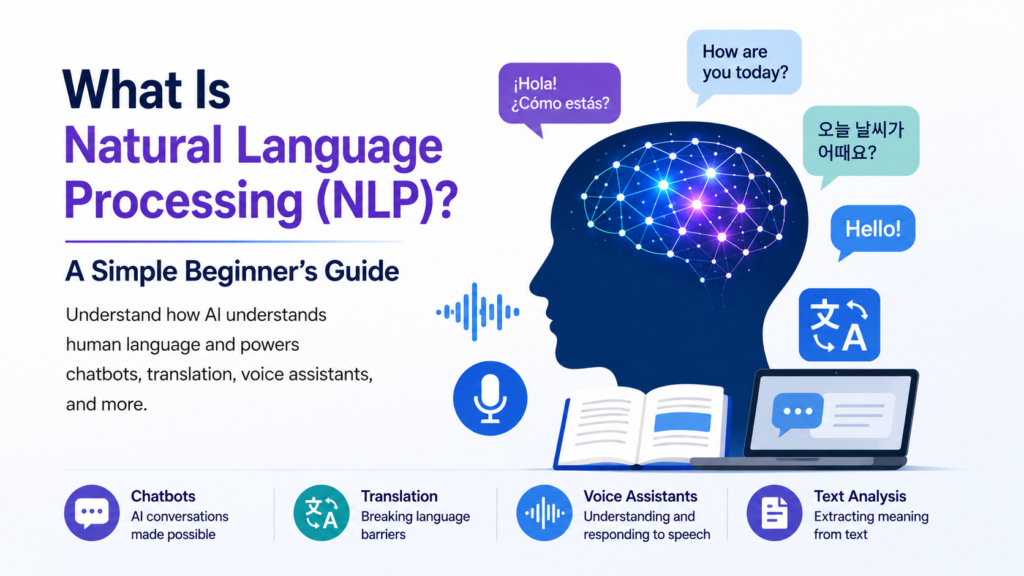
Natural Language Processing, commonly called NLP, is one of the technologies that helps computers work with human language.
Whenever you ask an AI chatbot a question, use voice-to-text, translate a sentence, or receive an automatically generated summary, Natural Language Processing may be involved.
For beginners, terms such as artificial intelligence, machine learning, deep learning, and NLP can sound complicated. But the basic idea behind NLP is surprisingly simple.
Natural Language Processing helps computers process, analyze, and generate human language.
In this guide, you will learn what Natural Language Processing is, how it works, where you may encounter it in everyday life, and why it has become so important in modern AI.
If you are completely new to artificial intelligence, start with our guide: What Is AI? A Simple Guide for Beginners
What Is Natural Language Processing?
Natural Language Processing is an area of artificial intelligence focused on helping computers process human language.
Human language is complicated.
The same word can have different meanings depending on the sentence. People also use slang, abbreviations, humor, questions, and many different writing styles.
NLP technologies are designed to help computer systems work with this complexity.
They can be used to process:
- Written text
- Spoken language after it has been converted into text
- Questions and commands
- Documents
- Conversations
Natural Language Processing is used in many applications people interact with every day.
How Does Natural Language Processing Work?
NLP systems use computational techniques to analyze language and identify useful patterns.
Modern NLP often combines machine learning and deep learning with other language-processing methods.
A simplified process can be understood in three steps.
1. Receiving Language
First, the system receives language as input.
For example, you might type:
“What will the weather be like tomorrow?”
The system receives the words and begins processing them.
2. Analyzing the Language
Next, the system analyzes patterns and relationships within the text.
Depending on the application, it may try to determine:
- Important words
- Relationships between words
- The meaning suggested by context
- What the user is asking
- What type of response may be appropriate
Modern AI systems can use deep learning models to handle increasingly complex language patterns.
To understand the technology behind many modern AI systems, read: What Is Deep Learning? A Simple Beginner’s Guide
3. Producing a Result
Finally, the system produces an output.
Depending on the task, it might:
- Answer a question
- Translate a sentence
- Summarize a document
- Classify a message
- Generate new text
The exact process varies considerably depending on the type of NLP system being used.
Natural Language Processing and Machine Learning
Natural Language Processing describes a field focused on working with human language, while machine learning provides methods that can be used to build many NLP systems.
Earlier NLP systems often relied heavily on rules written by people.
Modern systems increasingly use machine learning to learn language patterns from data.
This can help systems handle the variety and complexity of real-world language more effectively.
If you want to understand how these concepts are related, read: AI vs. Machine Learning: What’s the Difference?
NLP and Large Language Models
Large Language Models, or LLMs, are an important development in Natural Language Processing.
LLMs are trained to learn complex patterns in language from large amounts of data.
This allows modern AI systems to perform tasks such as:
- Answering questions
- Summarizing information
- Generating text
- Rewriting content
- Brainstorming ideas
- Explaining concepts
However, NLP and LLM are not interchangeable terms.
NLP is the broader field concerned with computers and human language. Large Language Models are one type of technology used for many modern language-related AI tasks.
For a more detailed explanation, read: What Are Large Language Models (LLMs)? A Simple Beginner’s Guide
Everyday Examples of Natural Language Processing
You may already use NLP-powered features regularly without realizing it.
AI Chatbots
Modern AI chatbots can process written questions and generate conversational responses.
You might use a chatbot to:
- Ask questions
- Brainstorm ideas
- Improve writing
- Summarize information
- Create plans
Language processing is a major part of what makes these interactions possible.
Translation Tools
Translation services analyze language patterns to convert text from one language into another.
Modern systems can consider context rather than simply translating each word separately.
Email Spam Filters
Language-processing techniques can help email services analyze messages and identify patterns associated with spam or unwanted content.
Search Engines
Search systems use language-processing technologies to better understand queries and determine what information a person may be looking for.
Voice Assistants
When you speak to a voice assistant, speech-recognition technology first helps convert your voice into a form a computer can process.
NLP can then help the system interpret the request and determine an appropriate action or response.
Writing and Grammar Tools
Writing assistants can analyze sentences and suggest improvements related to:
- Grammar
- Spelling
- Clarity
- Tone
- Sentence structure
These tools demonstrate how language-processing technology can assist with everyday communication.
How Generative AI Uses NLP
Natural Language Processing and generative AI are closely connected when the task involves language.
Traditional NLP applications may analyze, classify, or extract information from text.
Generative AI can go further by producing new content.
For example, a generative AI system might create:
- An email
- A summary
- A story
- A list of ideas
- An explanation
- A response to a question
This is one reason modern AI chatbots can feel very different from older rule-based computer programs.
To learn more about this technology, read: Generative AI Explained: A Beginner’s Guide
Why Context Matters in Human Language
One of the biggest challenges in language processing is context.
Consider the word “bank.”
It might refer to:
- A financial institution
- The side of a river
Humans can often determine the intended meaning by looking at the surrounding words.
AI language systems also need to use context to determine which meaning is more likely.
This becomes even more difficult with humor, sarcasm, cultural references, or ambiguous questions.
Context is one reason human language can be challenging for computers.
What Are the Limitations of NLP?
Natural Language Processing has improved significantly, but it is not perfect.
AI Can Misunderstand Meaning
Language can be ambiguous, and an AI system may interpret a sentence differently from what the user intended.
AI Can Produce Incorrect Information
Advanced language models can generate responses that sound confident even when some information is incorrect.
Important facts should be verified before relying on them.
Context Can Be Difficult
Long conversations, unusual expressions, sarcasm, or specialized terminology may create challenges for language-processing systems.
Training Data Matters
AI systems learn patterns from data, so the quality and characteristics of that data can influence their outputs.
These limitations are important reasons to use AI as a tool rather than assume every response is automatically correct.
Why Better Prompts Can Improve AI Responses
The way you communicate with an AI system can affect the quality of its response.
A vague request such as:
“Help me write something.”
provides very little context.
A clearer prompt might be:
“Write a friendly three-sentence email thanking a neighbor for helping me move.”
The second request gives the AI more information about the task, tone, length, and audience.
Learning how to provide clear instructions is therefore one of the most useful skills for everyday AI users.
For practical examples, read: How to Write AI Prompts: A Simple Beginner’s Guide
Why Should Beginners Understand NLP?
You do not need to become a programmer or data scientist to benefit from understanding Natural Language Processing.
Knowing the basic concept can help you understand:
- Why AI can answer questions
- How chatbots work with language
- Why prompts matter
- Why AI sometimes misunderstands requests
- Why AI-generated information still needs human review
It can also help make terms such as machine learning, deep learning, generative AI, and Large Language Models easier to understand.
For additional introductory information about Natural Language Processing, IBM’s Natural Language Processing overview provides a useful explanation of the concept and common applications.
Final Thoughts
Natural Language Processing is an important part of modern artificial intelligence.
It helps computers process human language and contributes to technologies such as AI chatbots, translation tools, search systems, writing assistants, and voice-based applications.
Modern NLP often works together with machine learning, deep learning, and Large Language Models to handle increasingly complex language tasks.
The most important idea for beginners is simple: NLP focuses on helping computers work with the language people use every day.
Understanding this concept gives you another important piece of the foundation needed to understand modern AI and use AI tools more effectively.