
Introduction
Artificial intelligence and machine learning are two terms that are often used together, but many people are confused about what they actually mean.
You may have heard people say:
- “AI is changing the world.”
- “Machine learning powers modern technology.”
- “AI tools can create content, answer questions, and make predictions.”
But are AI and machine learning the same thing?
The short answer is no.
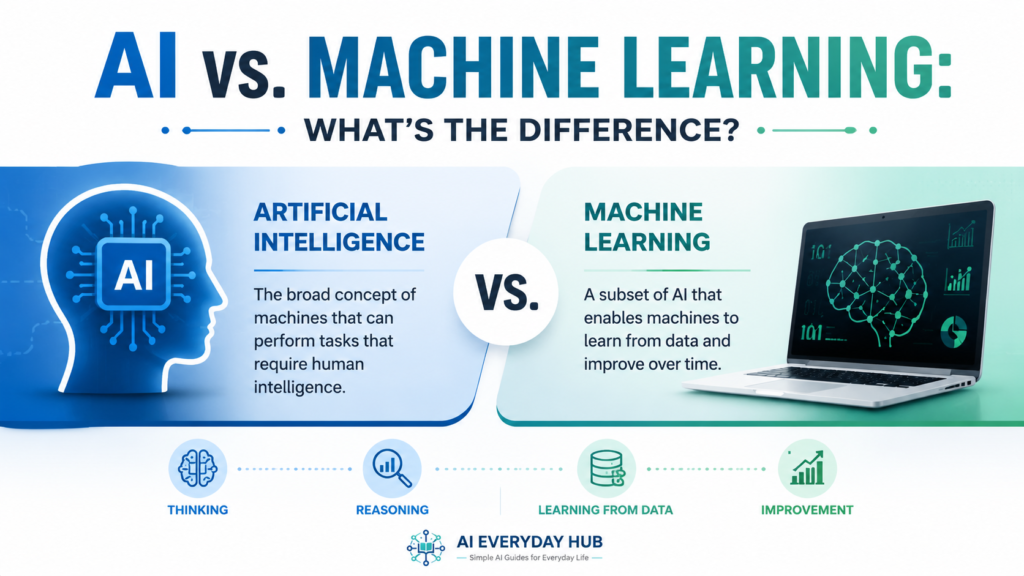
Machine learning is a part of artificial intelligence, but artificial intelligence is a much broader concept.
Understanding the difference between AI and machine learning can help beginners better understand how modern technology works and how tools they use every day are created.
In this guide, we will explain AI vs machine learning in simple terms, compare their differences, and explore real-life examples.
What Is Artificial Intelligence (AI)?
Artificial intelligence, commonly called AI, is the broader idea of creating computer systems that can perform tasks that normally require human intelligence.
These tasks may include:
- Understanding language
- Recognizing images
- Solving problems
- Making decisions
- Learning from information
- Creating content
AI does not mean that computers have human thoughts or emotions.
Instead, AI systems use technology, data, and mathematical methods to complete tasks in ways that appear intelligent.
Examples of AI include:
If you are new to artificial intelligence, start with our beginner guide: What Is AI? A Simple Guide for Beginners.
- Voice assistants
- Recommendation systems
- Navigation apps
- AI chatbots
- Image recognition systems
- Translation tools
To learn more about the basic idea of AI, read our guide:
What Is AI? A Simple Guide for Beginners
What Is Machine Learning?
Machine learning is a specific method used to create AI systems.
Instead of programming a computer with every possible rule, machine learning allows computers to learn patterns from examples and data.
For example, imagine teaching a computer to recognize pictures of dogs.
A traditional program might require humans to write thousands of rules describing what makes something a dog.
A machine learning system can analyze many examples of dog images and learn common patterns on its own.
Over time, the system becomes better at recognizing similar images.
Machine learning is one of the main technologies behind many modern AI applications.
You can learn more about machine learning concepts from Google’s Machine Learning educational resources.
The Relationship Between AI and Machine Learning
The easiest way to understand the relationship is to think about categories.
Imagine a large circle:
Artificial Intelligence (AI)
Inside that circle are different approaches, including:
- Machine Learning
- Deep Learning
- Natural Language Processing
- Computer Vision
Machine learning is one part of AI. To understand the basic process behind AI systems, read our guide: How Does AI Work? A Simple Explanation for Beginners.
A simple comparison:
AI = The goal of creating intelligent computer systems
Machine Learning = One method used to achieve that goal
AI vs Machine Learning: Key Differences
1. Purpose
The purpose of AI is to create systems that can perform tasks requiring human-like intelligence.
The purpose of machine learning is to allow computers to learn from data and improve their performance.
2. How They Work
AI systems may use different techniques, including:
- Rules
- Logic
- Data analysis
- Machine learning models
Machine learning specifically depends on data and patterns.
3. Scope
AI is the larger field.
Machine learning is a smaller area within AI.
Think of it this way:
AI is the entire house.
Machine learning is one important room inside that house.
4. Human Involvement
Some AI systems rely heavily on human-created rules.
Machine learning systems usually require humans to provide training data and define goals, but the system learns patterns from examples.
What Is Deep Learning?
Deep learning is another term beginners often hear.
Deep learning is a more advanced type of machine learning that uses structures called neural networks.
Neural networks are inspired by the way the human brain processes information, although they do not work exactly like a human brain.
Deep learning is especially useful for:
- Image recognition
- Speech recognition
- Language understanding
- Generative AI
Many modern AI tools use deep learning technology.
Real-Life Examples of AI and Machine Learning
You probably use AI and machine learning every day without noticing.
Search Engines
Search engines use AI technologies to understand what people are looking for and provide useful results.
Machine learning helps improve search results by learning from patterns and user interactions.
Streaming Recommendations
When Netflix, YouTube, or music services recommend content, machine learning analyzes patterns such as:
- What you watch
- What you listen to
- What similar users enjoy
The system uses these patterns to suggest possible choices.
Email Spam Detection
Email providers use machine learning to identify unwanted messages.
The system learns patterns from millions of emails to recognize characteristics of spam.
Navigation Apps
Navigation apps use AI-related technologies to analyze:
- Traffic conditions
- Travel patterns
- Route information
This helps provide better directions and estimated travel times.
AI Chatbots
Modern AI chatbots use advanced machine learning models to understand questions and generate responses.
These systems can help with:
- Writing
- Learning
- Planning
- Research
- Brainstorming
How Generative AI Uses Machine Learning
Generative AI is one of the most popular examples of modern AI.
Tools that create text, images, or other content rely heavily on machine learning.
During training, these systems analyze large amounts of information and learn patterns.
When a user provides a prompt, the AI uses what it learned to generate a response.
For example:
You ask:
“Create a simple explanation of photosynthesis for a beginner.”
The AI analyzes your request and creates an answer based on learned patterns.
To learn more about generative AI, read:
Generative AI Explained: A Beginner’s Guide
Why Understanding AI and Machine Learning Matters
Understanding these concepts helps you make better decisions about technology.
You can better understand:
- How AI tools work
- What AI can and cannot do
- Why AI sometimes makes mistakes
- How to use AI responsibly
You do not need to become a computer scientist to benefit from AI.
However, understanding the basics helps you use these tools more effectively.
Common Misunderstandings About AI and Machine Learning
“AI Thinks Like Humans”
AI can produce impressive results, but it does not think or experience the world like people do.
It processes information differently from human intelligence.
“Machine Learning Means Computers Learn Everything Automatically”
Machine learning systems still require:
- Data
- Training
- Human guidance
- Testing
They do not learn exactly like humans.
“AI Will Always Be Correct”
AI systems can make mistakes.
They may provide incorrect or incomplete information.
Always review important information before making decisions.
Should Beginners Learn About AI or Machine Learning First?
For most beginners, learning about AI first is the best approach.
Start with the bigger picture:
- Understand what AI is
- Learn how AI works
- Explore machine learning basics
- Try practical AI tools
- Learn how to use AI effectively
You do not need technical knowledge to begin.
The most important skill is learning how to use AI as a helpful tool.
Final Thoughts
AI and machine learning are closely connected, but they are not the same thing.
Artificial intelligence is the broader concept of creating intelligent computer systems.
Machine learning is one important method that allows computers to learn from data and improve their performance.
As AI technology continues to grow, understanding these basic concepts will help you use new tools with more confidence.
Whether you are using AI for work, learning, creativity, or everyday tasks, knowing the difference between AI and machine learning gives you a stronger foundation for the future.