
Introduction
How does AI work? Artificial intelligence may sound complicated, but the basic idea is easier to understand than you might think.
AI is already part of many things we use every day. It can help answer questions, recommend movies, organize information, translate languages, suggest driving routes, and even help write emails.
But how does AI actually work?
In simple terms, AI works by learning patterns from large amounts of data and using those patterns to make predictions, generate responses, or complete tasks.
In this beginner-friendly guide, we will explain how AI works step by step, without complicated technical language.
What Is Artificial Intelligence?
Artificial intelligence, or AI, refers to computer systems designed to perform tasks that normally require some form of human intelligence.
These tasks can include understanding language, recognizing images, finding patterns, making predictions, and generating new content.
For example, an AI system might help you:
- Answer a question
- Translate a sentence
- Recommend a movie
- Write an email
- Summarize a long document
- Recognize objects in a photo
- Plan a trip
AI does not necessarily “think” the same way a person does. Instead, it uses mathematical models and patterns learned from data to produce useful results.
If you are completely new to the subject, you may also want to read our beginner’s guide, What Is AI? A Simple Guide for Beginners.
How Does AI Work?
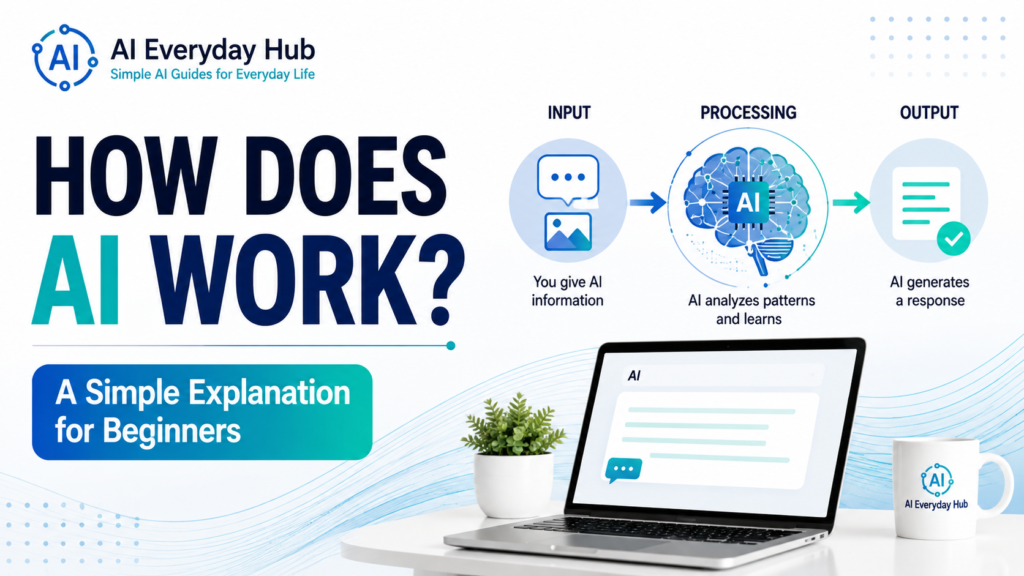
Most modern AI systems follow a basic process.
They receive information, analyze patterns they have learned, and then produce an output.
A simple way to understand this is:
Input → Processing → Output
For example, imagine asking an AI chatbot:
“Give me three easy dinner ideas using chicken and rice.”
Your question is the input.
The AI analyzes the words and context of your request. It uses patterns learned during its training to determine what type of response would be useful.
It then generates the output: three possible dinner ideas.
The actual technology behind this process can be extremely complex, but as a beginner, understanding this basic flow is a great place to start.
Step 1: AI Learns From Data
Data is one of the most important parts of artificial intelligence.
AI systems can be trained using large amounts of information. Depending on the system, this information may include text, images, audio, numbers, or other types of data.
During training, the AI looks for patterns and relationships within that information.
For example, an AI system trained to recognize cats might learn patterns associated with cat images.
A language-based AI system learns patterns in how words, sentences, ideas, and concepts relate to one another.
This process allows the AI to make useful predictions when it encounters new information.
Step 2: AI Recognizes Patterns
Humans recognize patterns naturally.
If you see dark clouds in the sky, you might predict that rain is coming because you have seen similar situations before.
AI also works with patterns, although it does so mathematically.
Suppose an AI system has been trained using many examples of emails. It may learn patterns that help distinguish between ordinary messages and spam.
Similarly, an AI language model can learn patterns in language that help it predict which words or ideas are likely to make sense in a response.
Pattern recognition is one of the key reasons AI can perform so many different tasks.
Step 3: AI Uses a Model
An AI model is the system that has learned patterns from training data.
You can think of a model as a highly sophisticated set of learned mathematical relationships.
Once trained, the model can receive new information and use what it has learned to generate a result.
Different AI models are designed for different purposes.
Some models specialize in images. Others work with speech, numbers, recommendations, or written language.
Generative AI models can create new content such as text, images, audio, or computer code based on a user’s instructions.
Step 4: AI Receives Your Input
When you use an AI tool, you usually give it some type of input.
For an AI chatbot, your input might be a question or instruction called a prompt.
For example:
“Explain photosynthesis in simple language for a 10-year-old.”
The AI analyzes your request and uses the information in your prompt to determine what kind of response you want.
This is why clear instructions can make such a big difference when using AI.
The more clearly you explain your goal, context, and desired result, the easier it is for an AI tool to provide a useful response.
Step 5: AI Generates an Answer
After processing your input, the AI produces an output.
With a language model, this often involves predicting a sequence of words that fits your request and the patterns the model learned during training.
This happens very quickly, which can make the response feel as though the AI immediately “knows” the answer.
However, this is an important distinction:
AI-generated answers are not automatically facts.
AI can sometimes produce incorrect, outdated, incomplete, or misleading information.
For important information, you should verify the answer using reliable sources.
A Simple Real-Life Example
Imagine that you want AI to help you plan your Saturday.
You might write:
“Help me create a Saturday schedule. I need two hours for grocery shopping, one hour for cleaning, and I want the afternoon free for my family.”
The AI receives your request as input.
It identifies important details such as the activities, time requirements, and your preference to keep the afternoon available.
Then it generates a possible schedule based on those instructions.
You can continue the conversation by saying:
“Move grocery shopping to 9:00 a.m.”
The AI can then adjust the response based on your new instruction.
This is one reason AI can be so useful for everyday tasks: you can refine the result through a conversation.
What Is Machine Learning?
Machine learning is an important part of modern artificial intelligence.
Instead of programming a computer with a separate rule for every possible situation, machine learning allows systems to learn patterns from examples.
For instance, rather than manually writing thousands of rules describing what spam email looks like, a machine-learning system can analyze many examples and learn patterns associated with spam.
Machine learning is used in many familiar technologies, including recommendation systems, fraud detection, image recognition, and language tools.
To learn more about artificial intelligence and machine learning, visit Google’s AI education resources.
What Is Generative AI?
Generative AI is a type of artificial intelligence designed to generate new content.
Depending on the tool, generative AI can create:
- Text
- Images
- Audio
- Video
- Computer code
- Ideas and outlines
AI chatbots are popular examples of generative AI.
You provide a prompt, and the system generates a response based on your instructions and patterns learned during training.
This makes generative AI particularly useful for brainstorming, learning, writing assistance, planning, summarizing, and many everyday tasks.
Does AI Think Like a Human?
Not exactly.
AI can generate responses that sound very natural, but that does not mean it understands the world exactly as humans do.
People use personal experiences, emotions, judgment, values, and real-world understanding when making decisions.
AI systems operate differently. They process information using learned patterns and mathematical calculations.
That is why AI should generally be viewed as a tool that can assist you rather than as a replacement for human judgment.
Why Does AI Sometimes Give Wrong Answers?
AI is powerful, but it is not perfect.
An AI system may occasionally provide information that sounds convincing but is incorrect. This is sometimes called an AI hallucination.
Mistakes can happen for several reasons. The AI may misunderstand your question, lack sufficient context, rely on patterns that do not lead to an accurate answer, or have limitations in the information available to it.
You can reduce problems by:
- Asking clear and specific questions
- Providing enough context
- Asking follow-up questions
- Comparing important information with reliable sources
- Avoiding sharing sensitive personal information unnecessarily
For medical, legal, financial, or other high-stakes decisions, AI should not be your only source of information.
How AI Is Used in Everyday Life
You may already use artificial intelligence without realizing it.
Common examples include:
Search engines: AI can help understand search queries and organize relevant results.
Streaming services: Recommendation systems suggest movies, shows, or music based on patterns and preferences.
Navigation apps: AI-related technologies can help analyze routes and traffic information.
Email: Systems may identify spam, suggest replies, or help organize messages.
Online shopping: Recommendation systems can suggest products based on browsing and purchasing patterns.
AI assistants: Generative AI tools can help explain information, brainstorm ideas, summarize text, and assist with everyday planning.
AI is becoming increasingly integrated into ordinary digital tools.
Do You Need Technical Skills to Use AI?
For many everyday AI tools, the answer is no.
You usually do not need to understand programming, algorithms, or advanced mathematics.
The most useful beginner skill is simply learning how to explain what you want clearly. If you want to practice this skill, read our beginner-friendly guide, How to Write AI Prompts: A Simple Beginner’s Guide. https://aieverydayhub.com/how-to-write-ai-prompts/
Instead of writing:
“Plan dinner.”
you could write:
“Create a simple five-day dinner plan for two adults. Keep each meal under 30 minutes and use common grocery-store ingredients.”
The second prompt gives the AI much more useful context.
Small improvements in your instructions can lead to much better results.
Final Thoughts
Understanding how AI works can make artificial intelligence feel much less complicated.
AI systems learn patterns from data, use trained models to process information, and generate outputs based on the input they receive.
For everyday users, you do not need to understand all of the mathematics behind AI to benefit from it.
Start with simple tasks. Ask clear questions. Experiment with different prompts. And always remember to verify important information rather than assuming every AI-generated answer is correct.
The more you understand how AI works, the easier it becomes to use AI confidently and responsibly in everyday life.