
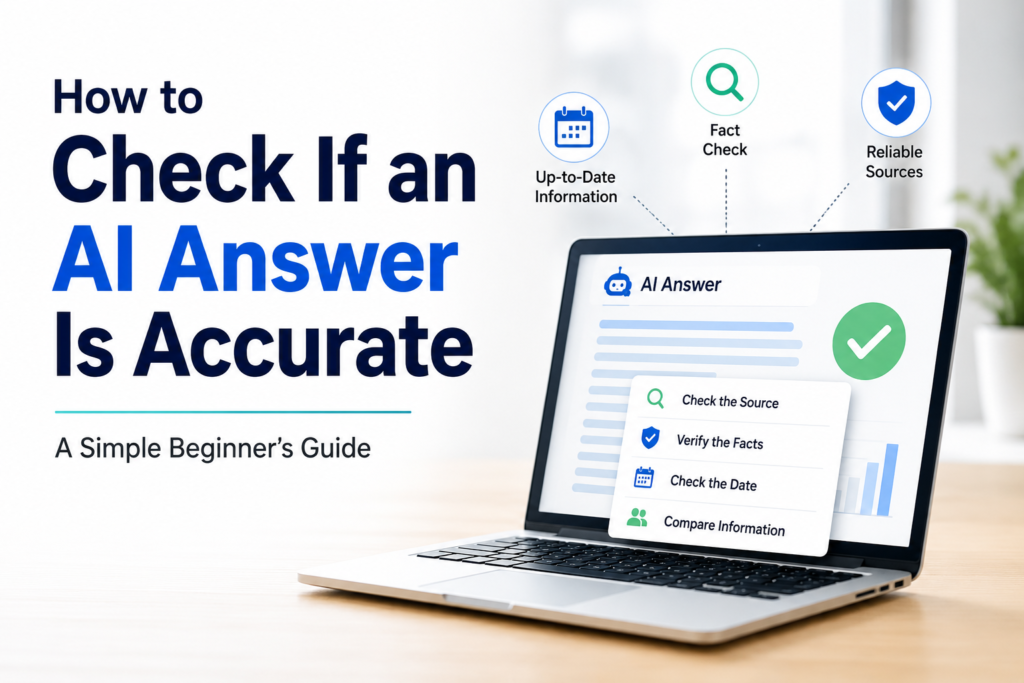
Introduction
AI can answer questions in seconds, explain difficult topics, summarize information, and help with everyday decisions.
But there is one important rule every AI user should remember:
An AI answer can sound confident and still be wrong.
AI systems can sometimes provide outdated information, incorrect facts, misleading explanations, or even sources that do not exist.
That does not mean AI is not useful. It means you need to know when and how to verify what AI tells you.
In this guide, you will learn how to check if an AI answer is accurate using simple steps that anyone can follow.
If you are wondering why AI sometimes produces incorrect information in the first place, read our guide: What Are AI Hallucinations? A Simple Beginner’s Guide
Why Should You Check AI Answers?
AI-generated information should not automatically be treated as verified fact.
Depending on the question, an AI response may contain:
- Incorrect dates
- Outdated information
- Wrong names
- Inaccurate statistics
- Misleading explanations
- Invented sources
- Information taken out of context
Some mistakes are easy to notice.
Others can be difficult to detect because the response may be detailed, well written, and confident.
This is why verification is especially important when you plan to use AI-generated information for something that matters.
Step 1: Identify the Claims That Need Verification
You do not necessarily need to fact-check every sentence an AI produces.
Start by identifying statements that can be objectively checked.
Pay particular attention to:
- Dates
- Names
- Numbers
- Statistics
- Quotes
- Research findings
- Laws and regulations
- Product specifications
- Current events
- Medical information
- Financial information
For example, imagine an AI tells you:
“Company X launched this product in 2021.”
The year is a specific factual claim that can be verified.
Instead of accepting it immediately, check the company’s official website or another reliable source.
Step 2: Ask the AI for Its Sources
A simple next step is to ask:
“What sources support this answer?”
You can also be more specific:
“Provide reliable sources for the factual claims in your answer.”
This can help you identify information that needs further checking.
However, there is an important warning.
Do not assume a source is real simply because an AI provides it.
AI systems can sometimes generate citations, article titles, authors, or links that appear legitimate but are inaccurate or nonexistent.
Always open and check important sources yourself.
Step 3: Open the Original Source
If the AI gives you a source, go to the source itself.
Do not rely only on the AI’s description of what the source supposedly says.
Once you open it, check:
- Does the page actually exist?
- Is the organization or author clearly identified?
- Does the page contain the information the AI claimed?
- Is the information still current?
- Is the AI representing the source accurately?
This step is especially important when an AI provides a specific study, report, statistic, or quotation.
Step 4: Prefer Primary and Authoritative Sources
When possible, verify important information using the organization responsible for the information.
Examples include:
- Government agencies
- Universities
- Official company websites
- Original research organizations
- Official product documentation
- Recognized professional organizations
Suppose you want to verify information about a government program.
A government agency’s official website is generally a better starting point than an unknown blog repeating the same information.
For a company’s product specifications, check the manufacturer’s official documentation when possible.
Step 5: Compare More Than One Reliable Source
One source is useful.
Two or more independent reliable sources can give you greater confidence.
Imagine an AI provides a historical date.
You might verify it using:
- An official institution or archive
- A respected educational or reference source
If reliable independent sources agree, you have stronger evidence that the information is accurate.
If they disagree, investigate further rather than choosing whichever answer you prefer.
Step 6: Check the Publication Date
Information can be accurate when published and become outdated later.
This is particularly important for topics such as:
- Technology
- Software
- Prices
- Travel requirements
- Laws
- Government programs
- Company policies
- Product features
- Current events
Always look for a publication date or a “last updated” date when freshness matters.
For example, an article from several years ago may not accurately describe the current features of an AI service.
Step 7: Verify Quotes Separately
Quotes deserve special attention.
If an AI tells you that a famous person said something, search for the original speech, interview, book, transcript, or another reliable record.
Do not assume quotation marks mean the words are authentic.
AI can occasionally:
- Change wording
- Combine different statements
- Attribute a quote to the wrong person
- Generate a quote that was never said
If you cannot locate a trustworthy original or reliable record, avoid presenting the quotation as verified.
Step 8: Check Statistics and Numbers
Specific numbers can make an AI response appear authoritative.
But numbers should be verified carefully.
For a statistic, ask:
- Who collected the data?
- When was it collected?
- What population was measured?
- Is the original report available?
- Is the AI interpreting the statistic correctly?
A percentage without context can be misleading even when the number itself is technically correct.
Whenever possible, find the original dataset, report, or organization that published the statistic.
Step 9: Be Extra Careful With High-Stakes Information
Some information deserves much more verification than ordinary everyday questions.
Be particularly cautious with:
- Medical advice
- Legal information
- Financial decisions
- Taxes
- Safety instructions
- Major purchases
AI can help you understand terminology or prepare questions, but it should not automatically replace an appropriate qualified professional or authoritative source.
The higher the potential consequence of an error, the more carefully the information should be verified.
Step 10: Ask the AI to Identify Uncertainty
You can also ask AI to separate what it knows with greater confidence from what may be uncertain.
For example:
“Which parts of your answer should I independently verify?”
Or:
“If any information in your answer is uncertain, clearly identify it.”
This does not guarantee accuracy.
However, it can make the response easier to review and encourage a more cautious answer.
Step 11: Ask the Same Question in a Different Way
Another useful technique is to ask the question again using different wording.
For example, first ask:
“When was this program introduced?”
Then ask:
“Give me a timeline of this program and include sources for each important date.”
If the AI provides significantly different answers, that is a signal that you should investigate further.
However, matching AI answers are still not proof of accuracy. Independent sources remain more important.
Step 12: Separate Facts From Suggestions
Not every AI response contains only factual claims.
An AI may mix:
- Facts
- Explanations
- Opinions
- Suggestions
- Predictions
- Creative ideas
Learn to separate them.
For example:
“This laptop weighs 3.2 pounds.”
is a factual claim that can be checked.
But:
“This is the best laptop for most people.”
is a recommendation that depends on needs, preferences, price, and other factors.
Recognizing the difference helps you decide what needs factual verification.
A Simple 3-Source Verification Method
For important factual information, beginners can use a simple method.
Source 1: The Original or Official Source
Start with the organization directly responsible for the information.
Source 2: A Reliable Independent Source
Find another trustworthy organization that reports or explains the same information.
Source 3: A Second Independent Check
For especially important claims, use another reliable source to confirm the details.
You do not need three sources for every everyday question.
The purpose is to increase the level of verification as the importance of the information increases.
Example: Checking an AI Answer
Imagine you ask:
“When did a particular AI product launch?”
The AI provides a date.
Here is how you could check it.
First
Visit the company’s official website and look for the original product announcement.
Second
Find a reputable independent publication reporting the launch.
Third
Compare the dates and details.
If both reliable sources agree with the AI response, you have stronger evidence that the answer is accurate.
If they do not agree, continue investigating.
Can You Use Google to Check an AI Answer?
Yes, but simply finding the same statement in search results does not automatically prove it is correct.
Search engines can lead to:
- Official sources
- High-quality journalism
- Academic research
- Government information
But they can also lead to inaccurate or low-quality websites.
The important skill is not simply searching.
It is evaluating the source you find.
Google provides tools and guidance designed to help users evaluate online information. Its About this result features can provide additional context about search results and their sources.
Can You Ask Another AI to Verify the Answer?
You can, but this should not be your only verification method.
Two AI systems may produce the same incorrect information because they may rely on similar patterns or sources.
Another AI can help you:
- Identify claims to check
- Suggest search terms
- Explain conflicting information
- Find questions you should investigate
But for important factual verification, use reliable external sources.
AI Answers About Current Information Need Extra Checking
AI systems may not always have the latest information.
This matters when asking about:
- Today’s news
- Current prices
- Recent product updates
- Current laws
- Travel restrictions
- Sports results
- Company leadership
- Software features
When the answer depends on what is happening now, check a current authoritative source and pay attention to the date.
A Quick AI Answer Accuracy Checklist
Before relying on an important AI answer, ask yourself:
- Is this a factual claim?
- Can I find the original source?
- Does the source really support the claim?
- Is the information current?
- Can another reliable source confirm it?
- Are the quoted words authentic?
- Can I verify the statistics?
- Would an error have serious consequences?
If the answer matters, taking a few extra minutes to check these questions can prevent avoidable mistakes.
How AI Training and Inference Affect Answers
Understanding how AI works can also help you understand why verification matters.
An AI model learns patterns during training.
Later, during inference, the trained model uses those patterns and the available context to generate an output.
The model’s ability to produce a fluent answer does not guarantee that every factual detail is correct.
To understand this process, read: What Is AI Inference? A Simple Beginner’s Guide
You can also learn more about the underlying system in: What Is an AI Model? A Simple Beginner’s Guide
Build a Habit of Verification
The goal is not to become suspicious of every sentence AI generates.
AI can be extremely useful for:
- Brainstorming
- Explaining concepts
- Organizing information
- Creating drafts
- Summarizing material
- Generating ideas
Instead, develop a simple habit:
Use AI for assistance. Verify important facts before relying on them.
This approach allows you to benefit from AI while reducing the risk of acting on inaccurate information.
Why This Skill Matters
Knowing how to check if an AI answer is accurate is becoming an important digital skill.
As AI becomes more common in search, writing, education, work, and everyday life, people need to understand both its strengths and its limitations.
The best AI users are not necessarily the people who accept every answer.
They are the people who know when an answer needs verification and where to look for trustworthy information.
For additional guidance on evaluating online information, Google Search’s information literacy guidance provides tools and techniques that can help you learn more about sources and evaluate information found online.
Final Thoughts
AI can provide useful answers quickly, but speed and confidence do not guarantee accuracy.
When an answer matters, identify the important claims, check original sources, compare reliable information, examine dates, and verify quotes and statistics.
Remember the simplest rule:
AI can help you find and understand information, but important facts should still be verified.
Once you develop this habit, you can use AI with greater confidence while avoiding many of the problems caused by inaccurate or fabricated information.