
Introduction
AI tools can help you research topics, explain complicated ideas, summarize information, and answer questions in seconds.
But AI-generated information is not automatically accurate.
An AI system can sometimes produce incorrect dates, misleading statistics, invented quotations, outdated information, or sources that do not exist. Because these answers can sound professional and confident, mistakes are not always easy to recognize.
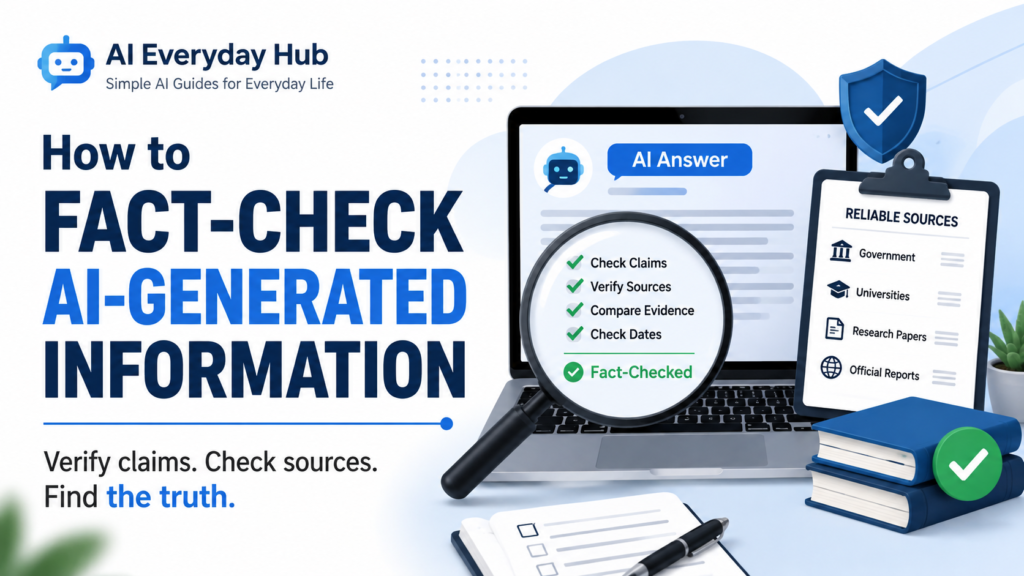
That is why learning how to Fact-Check AI-Generated Information is becoming an important skill for everyday AI users.
Fact-checking does not mean distrusting everything AI tells you. It means identifying important claims and checking them against reliable evidence before you rely on them.
In this beginner-friendly guide, you will learn a practical step-by-step process for fact-checking information generated by AI.
If you have not already read it, our guide How to Check If an AI Answer Is Accurate explains the basic principles of evaluating an AI response.
What Does It Mean to Fact-Check AI-Generated Information?
To fact-check AI-generated information means to examine specific claims in an AI response and determine whether reliable evidence supports them.
Suppose an AI chatbot tells you:
“A new technology was introduced in 2019 and is now used by more than 70% of American businesses.”
There are at least two factual claims in that sentence:
- The technology was introduced in 2019.
- More than 70% of American businesses use it.
Instead of asking whether the entire answer “sounds right,” you can investigate those claims separately.
This is the foundation of practical fact-checking.
Why Can AI-Generated Information Be Wrong?
Generative AI models produce responses using patterns learned from data and information available in the context of a request.
They can produce remarkably useful answers, but fluent language does not guarantee factual accuracy.
AI may sometimes:
- Mix information from different sources
- Provide outdated information
- Misinterpret context
- Generate an incorrect number or date
- Attribute information to the wrong source
- Produce a source that sounds real but does not exist
This behavior is often discussed in connection with AI hallucinations.
For a detailed explanation, read What Are AI Hallucinations? A Simple Beginner’s Guide.
Step 1: Break the AI Answer Into Individual Claims
The first step is to stop looking at the response as one large block of text.
Instead, identify individual claims that can be checked.
Imagine an AI response says:
“The company launched in 2015, introduced its first AI product in 2018, and currently serves more than 10 million customers.”
That response contains at least three claims:
- The company launched in 2015.
- Its first AI product appeared in 2018.
- It currently serves more than 10 million customers.
Each claim can be investigated separately.
This makes fact-checking much easier.
Step 2: Decide Which Claims Matter Most
Not every sentence needs the same amount of verification.
Focus first on claims that could change your understanding or influence a decision.
These often include:
- Dates
- Statistics
- Names
- Quotes
- Research findings
- Historical events
- Product specifications
- Prices
- Laws and regulations
- Health information
- Financial information
- Current events
The more important the claim, the stronger the evidence you should require.
Step 3: Search for the Original Source
One of the best ways to Fact-Check AI-Generated Information is to look for the original source behind a claim.
Suppose AI tells you:
“According to a 2025 university study, 62% of participants reported a particular result.”
Do not simply search for websites repeating “62%.”
Try to find the actual study.
Search using combinations such as:
University name + topic + study
or:
Exact statistic + study
or:
Researcher name + study title
If the original research exists, examine what it actually says.
Step 4: Prefer Primary Sources When Possible
A primary source comes directly from the organization, researcher, agency, or company responsible for the information.
Examples include:
- Government reports
- Original research papers
- University publications
- Official company announcements
- Product documentation
- Court documents
- Official statistics
For example, if AI gives you information about a feature of a software product, the company’s current official documentation is often a stronger source than a random blog describing that feature.
If AI provides a government statistic, look for the agency that originally collected or published the data.
Step 5: Check Whether the Source Actually Exists
AI can sometimes generate a convincing-looking source that is not real.
A citation might contain:
- A realistic article title
- A believable author’s name
- A respected publication
- A publication year
- A supposed research paper
But those details do not prove the source exists.
Search for the exact title.
Then confirm:
- The article or study exists
- The listed author actually wrote it
- The publication published it
- The date is correct
If you cannot locate the supposed source through reasonable searching, do not treat the citation as verified.
Step 6: Check Whether the Source Supports the Claim
Finding a real source is only half the job.
You must also determine whether that source actually supports what the AI said.
For example, an AI response might claim:
“A study proved that using a particular tool increases productivity by 40%.”
You locate the study, but discover that it actually found a 40% improvement only among a small group performing one particular task.
The source exists, but the AI may have overstated its conclusion.
Always compare the AI’s wording with the original evidence.
Step 7: Investigate Who Is Behind the Source
When you encounter an unfamiliar website, article, or organization, investigate the source itself.
Ask:
- Who published this?
- Who is the author?
- Does the author have relevant expertise?
- What organization operates the website?
- Why was the information published?
- What do other reliable sources say about this organization?
Google recommends looking beyond an unfamiliar source itself and checking what independent sources say about it.
This approach helps you avoid judging credibility only by how professional a webpage looks.
Step 8: Use Lateral Reading
Professional fact-checking often involves looking outside the page you are evaluating.
This approach is commonly called lateral reading.
Instead of spending several minutes studying one unfamiliar website, open another tab and investigate the organization.
Search for:
Organization name + reviews
Organization name + university
Organization name + news
Organization name + controversy
The goal is not to find something negative.
The goal is to understand who is behind the information before trusting it.
Stanford’s Civic Online Reasoning resources emphasize checking who is behind information, examining the evidence, and seeing what other sources say.
Step 9: Compare Independent Sources
After locating the original source, look for independent confirmation.
This is sometimes called cross-checking or corroboration.
Suppose AI tells you that a government agency changed an important rule.
You might check:
- The government agency’s official website
- A reputable independent news organization
- Another authoritative source discussing the change
If independent reliable sources agree on the key facts, your confidence increases.
If they disagree, investigate why.
Step 10: Make Sure Sources Are Truly Independent
This step is easy to overlook.
Imagine three websites contain exactly the same statistic.
At first, it appears that three independent sources confirm the claim.
But when you investigate, you discover:
Website B copied Website A.
Website C also copied Website A.
You actually have only one original source.
Multiple websites repeating the same claim do not necessarily provide independent confirmation.
Try to trace information back to where it originated.
Step 11: Check the Date Carefully
Dates matter.
A source can be trustworthy and still be outdated.
This is especially important for:
- AI tools
- Software
- Technology
- Travel requirements
- Laws
- Prices
- Company policies
- Government programs
- Product features
- Current events
For rapidly changing topics, check both:
When was the information published?
and
When was it last updated?
Google’s guidance on evaluating information also recommends considering publication dates because older information may be less relevant for topics that change over time.
Step 12: Verify Statistics at Their Source
Statistics deserve extra attention because numbers can make weak claims appear authoritative.
If AI says:
“78% of consumers prefer AI-powered customer service.”
Ask:
78% of whom?
Then investigate:
- Who conducted the survey?
- How many people participated?
- Where were participants located?
- When was the survey conducted?
- How was the question worded?
- Who funded the research?
Try to find the original report rather than relying on another website quoting the number.
Step 13: Verify Quotations
AI-generated quotations should never be assumed to be authentic.
If AI attributes a statement to someone, search for:
- The original interview
- Speech transcript
- Official publication
- Book
- Video
- Reliable archival source
Searching a distinctive part of the quotation inside quotation marks can also help.
If you cannot find credible evidence that the person actually said it, do not present the quotation as verified.
Step 14: Watch for Missing Context
Sometimes an AI-generated statement is technically true but misleading because important context is missing.
For example:
“Sales increased by 100%.”
That sounds impressive.
But suppose sales increased from one product to two products.
The percentage is mathematically correct, but the context changes how you interpret it.
When fact-checking, ask:
What information would I need to understand this claim correctly?
Step 15: Distinguish Facts From Opinions
AI responses often combine factual statements with recommendations or opinions.
Consider these two statements:
“This laptop weighs 2.8 pounds.”
“This is the best laptop for travelers.”
The first is a factual claim that can be checked against specifications.
The second is a judgment that depends on factors such as:
- Price
- Battery life
- Screen size
- Performance
- Personal preferences
Do not fact-check an opinion as though it were an objective fact.
Instead, identify the criteria behind the recommendation.
Step 16: Search Using Neutral Language
The wording of your search can affect what you find.
Suppose you want to investigate whether a particular technology is safe.
Instead of searching:
“Why is Technology X dangerous?”
try:
“Technology X safety research”
or:
“Technology X safety evidence”
Neutral search terms make it easier to encounter different perspectives and evidence.
Google similarly recommends using neutral terms and trying different searches when evaluating information online.
Step 17: Do Not Automatically Trust the First Search Result
The first search result is not automatically the best evidence.
Scan several results before deciding what to open.
Look for:
- Primary sources
- Government agencies
- Universities
- Recognized research organizations
- Official documentation
- Reputable independent reporting
Stanford’s Civic Online Reasoning materials describe this practice as click restraint—examining search results before automatically choosing the first one.
Step 18: Use Fact-Checking Resources When Appropriate
Some widely shared claims may already have been investigated by professional fact-checkers.
Searching the key claim along with words such as:
fact check
can sometimes help locate existing investigations.
Google Search can also surface fact-check information from independent organizations when relevant fact checks are available.
However, you should still examine who performed the fact-check and what evidence they used.
Step 19: Ask AI to Help You Fact-Check — Carefully
AI itself can help organize the fact-checking process.
For example, you could ask:
“Separate this answer into factual claims that I should verify.”
Or:
“Which statements in this response depend on dates, statistics, research, or external sources?”
Another useful prompt is:
“Create a verification checklist for the claims in this answer. Do not assume the claims are correct.”
AI can help you identify what to investigate.
But do not ask AI to be the only judge of whether its own answer is accurate.
Independent evidence is still essential.
Step 20: Give Each Claim a Simple Verdict
After investigating a claim, classify it.
You can use a simple system:
Supported
Reliable evidence supports the claim.
Unsupported
You cannot find sufficient reliable evidence.
Misleading
Some part of the claim is correct, but important context is missing or distorted.
Incorrect
Reliable evidence contradicts the claim.
Outdated
The claim may once have been accurate but is no longer current.
This prevents you from treating complicated claims as simply “true” or “false.”
A Practical Fact-Checking Example
Imagine AI tells you:
“A certain AI tool was released in March 2023 and reached 50 million users within two months.”
Here is how you could investigate it.
Claim 1
The tool launched in March 2023.
Look for the company’s original announcement.
Claim 2
The tool reached 50 million users within two months.
Look for the original source of that user statistic.
Check the Evidence
Determine whether reputable independent sources report the same numbers.
Check the Date
Make sure later articles are not confusing current user numbers with the numbers from the original launch period.
Reach a Verdict
Only after checking the evidence should you decide whether each claim is supported.
This method is much more reliable than simply asking another AI:
“Is this true?”
Fact-Checking AI Images
AI-generated misinformation is not limited to text.
Images can also be:
- AI-generated
- Edited
- Cropped
- Taken out of context
- Reused from an unrelated event
If an image is important to a claim, investigate where it first appeared.
Reverse image search and image-context tools can sometimes help identify earlier versions of an image.
Google also provides tools that can show additional context about images and where they may have appeared online.
When Should You Spend More Time Fact-Checking?
The amount of verification should depend on the consequences of being wrong.
You probably do not need an hour of research to verify a casual movie recommendation.
But you should use much stronger verification for:
- Health decisions
- Legal matters
- Financial decisions
- Taxes
- Safety information
- Academic research
- Major purchases
- Important travel requirements
A useful rule is:
The greater the consequence of an error, the stronger the verification should be.
A Simple Fact-Checking Checklist
Before relying on important AI-generated information, ask:
- What exactly is the claim?
- What is the original source?
- Does that source actually exist?
- Does the source really support the claim?
- Who created the source?
- Is the source qualified to discuss the topic?
- Is the information current?
- Can an independent reliable source confirm it?
- Are statistics presented with context?
- Are quotations authentic?
- Could important context be missing?
If you cannot answer several of these questions, treat the information cautiously.
How Fact-Checking Fits Into Responsible AI Use
Fact-checking is not about proving that AI is unreliable.
It is about using AI appropriately.
AI can be excellent for:
- Brainstorming
- Drafting
- Summarizing
- Organizing ideas
- Explaining concepts
- Generating questions
- Starting research
But AI-generated information becomes much more useful when you know how to evaluate it.
Understanding What Is an AI Model? A Simple Beginner’s Guide can help explain what is happening behind the scenes when AI generates an answer.
And understanding What Is AI Inference? A Simple Beginner’s Guide helps explain how a trained model produces an output from new input.
Build a Simple Verification Habit
You do not need to become a professional fact-checker every time you use AI.
For everyday use, remember three questions:
Who is behind the information?
What evidence supports the claim?
What do other reliable sources say?
These questions closely reflect the approach taught by Stanford’s Civic Online Reasoning program for evaluating online information.
Developing this habit can help you use AI more confidently without automatically trusting everything it generates.
Final Thoughts
Learning how to Fact-Check AI-Generated Information is an increasingly useful skill for anyone who uses artificial intelligence.
Start by breaking an AI answer into individual claims.
Then find the original source, examine the evidence, investigate who created the information, check dates and statistics, and compare independent sources.
Most importantly, remember:
A convincing AI answer is not the same thing as verified information.
AI can help you find ideas and understand information faster. Fact-checking helps you decide what information deserves your trust.