
Introduction
AI Hallucinations are one of the most important limitations to understand when using modern artificial intelligence.
AI tools can produce impressive answers, explain complicated topics, summarize information, and help with everyday tasks. But sometimes an AI system can provide information that sounds confident and believable even though it is inaccurate, unsupported, or completely made up.
This type of incorrect AI-generated information is commonly called an AI hallucination.
For beginners, understanding AI Hallucinations is important because AI-generated answers should not automatically be treated as facts.
In this guide, you will learn what AI Hallucinations are, why they happen, what they can look like, and how you can reduce the risk of relying on incorrect AI-generated information.
If you are new to artificial intelligence, start with our guide: What Is AI? A Simple Guide for Beginners
What Are AI Hallucinations?
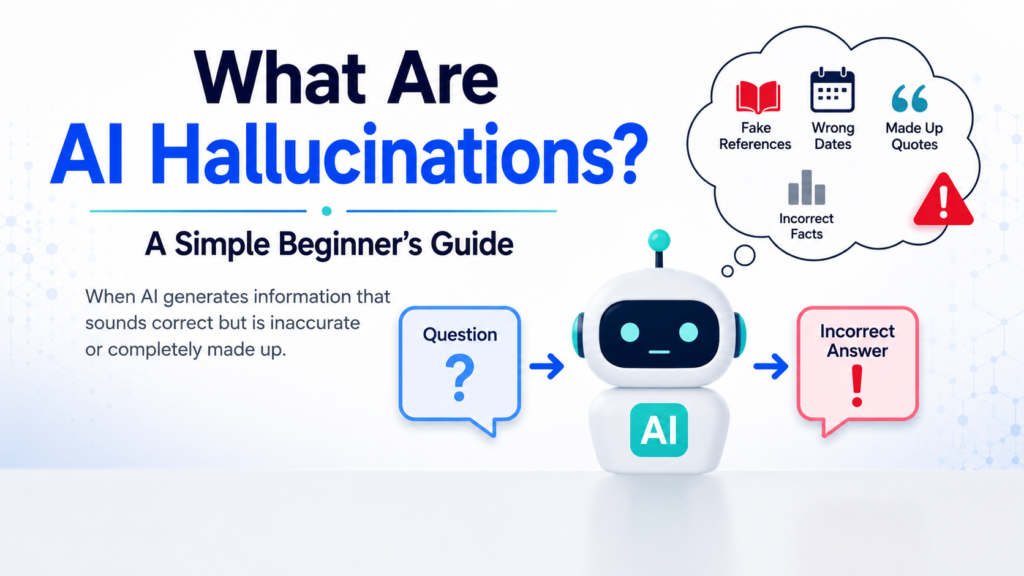
AI Hallucinations occur when an AI system generates information that appears plausible but is inaccurate, unsupported, or fabricated.
For example, an AI chatbot might:
- Invent a book that does not exist
- Provide an incorrect date
- Attribute a quote to the wrong person
- Create a nonexistent source
- Give inaccurate statistics
- Describe an event that never happened
The answer may still sound natural and confident.
That is what can make AI Hallucinations difficult to notice.
An AI system does not necessarily know that the information it generated is incorrect.
Why Do AI Hallucinations Happen?
To understand AI Hallucinations, it helps to understand how modern AI models generate answers.
Large Language Models do not simply retrieve a guaranteed correct answer from a database every time you ask a question.
Instead, they process the prompt and generate an output based on patterns learned during training and the context available to them.
This process can produce extremely useful responses, but it can also produce errors.
For a beginner-friendly explanation of these models, read: What Are Large Language Models (LLMs)? A Simple Beginner’s Guide
Several factors can contribute to AI Hallucinations.
1. AI Predicts Patterns
Language models generate text by predicting likely sequences of tokens based on learned patterns and context.
This allows them to create fluent and natural-sounding responses.
However, a response that is statistically plausible is not necessarily factually correct.
An AI model can therefore produce a sentence that sounds convincing even when the underlying information is wrong.
2. Training Data Can Be Imperfect
AI models learn patterns from training data.
That data may contain:
- Incorrect information
- Outdated information
- Conflicting information
- Missing context
- Incomplete examples
The quality and characteristics of training data can affect model behavior.
To understand how models learn from data, read: How Is AI Trained? A Simple Beginner’s Guide
3. The Prompt May Be Unclear
Vague or confusing prompts can make it more difficult for an AI system to determine what the user wants.
For example:
“Tell me about that famous study.”
does not provide enough information to identify which study the user means.
A clearer prompt would provide details such as the topic, researcher, date, or field.
Clearer instructions do not guarantee a correct answer, but they can reduce ambiguity.
4. The AI May Not Have Enough Reliable Context
Sometimes a user asks about highly specific, obscure, recent, or specialized information.
If the model does not have enough reliable context, it may still attempt to generate an answer.
This can increase the risk of inaccurate information.
A better AI system may sometimes acknowledge uncertainty, but users should still verify important claims.
5. AI Is Designed to Generate Useful Responses
Generative AI systems are designed to produce outputs in response to user requests.
When reliable information is limited, a model may still generate a plausible-looking response rather than simply remaining silent.
This is one reason fluent writing should not be confused with factual accuracy.
To understand the broader technology behind AI-generated content, read: Generative AI Explained: A Beginner’s Guide
A Simple Example of an AI Hallucination
Imagine asking an AI chatbot:
“What year did a particular company launch its first product?”
Suppose the correct answer is 2012.
The AI responds:
“The company launched its first product in 2010.”
The response is clearly written and may even include additional details.
But if the date is wrong, the answer contains inaccurate information.
Now imagine that the AI also provides the title of a supposed news article supporting the answer, but that article does not exist.
That would be an even clearer example of an AI hallucination.
Can AI Hallucinations Sound Confident?
Yes.
This is one of the most important things beginners should understand.
An incorrect AI response may not contain obvious warning signs.
The system might provide:
- Detailed explanations
- Professional language
- Specific dates
- Names
- Statistics
- Supposed references
These details can make an answer appear trustworthy.
But confidence in the wording is not proof of accuracy.
When accuracy matters, verify the information independently.
Common Types of AI Hallucinations
AI Hallucinations can appear in several forms.
Incorrect Facts
The AI may provide a wrong date, name, location, number, or historical detail.
Invented Sources
An AI system may occasionally generate references to articles, books, studies, or websites that do not exist.
Incorrect Quotes
AI may attribute words to a person who never said them or reproduce a quote inaccurately.
Fabricated Details
A response may include realistic-sounding details that are unsupported or invented.
Incorrect Connections
The AI may combine real pieces of information in a way that creates a false conclusion.
Understanding these patterns can make incorrect responses easier to recognize.
AI Hallucinations and AI Inference
AI Hallucinations can also be understood in relation to inference.
After an AI model has been trained, it uses its learned parameters to process new inputs and generate outputs.
This process is called inference.
The model produces an output based on learned patterns and the context available at that moment.
Because inference does not guarantee factual correctness, an output can sometimes contain hallucinated information.
For a complete explanation, read: What Is AI Inference? A Simple Beginner’s Guide
Are AI Hallucinations the Same as Lying?
Not exactly.
Calling an AI hallucination a “lie” can be misleading because lying normally implies that someone knows the truth and intentionally chooses to deceive another person.
An AI model does not necessarily have that kind of intent or awareness.
It generates outputs through computational processes.
Therefore, it is usually more accurate to describe the result as incorrect, fabricated, or unsupported information rather than intentional deception.
How Can You Spot an AI Hallucination?
There is no perfect method for identifying every hallucination, but several warning signs can help.
Check Very Specific Claims
Be cautious when an AI response includes highly specific:
- Dates
- Statistics
- Names
- Research findings
- Quotes
- Legal claims
- Medical claims
- Financial information
These types of details are often worth verifying.
Check the Sources
If an AI provides a source, confirm that the source actually exists.
Then check whether the source really supports the claim.
A real-looking citation is not enough.
Compare Multiple Reliable Sources
For important information, compare the AI-generated answer with trustworthy independent sources.
For example, you might check:
- Government websites
- Universities
- Established research organizations
- Official company documentation
- Reputable publications
Look for Contradictions
If different parts of an AI response contradict each other, that can be a warning sign.
You can ask the AI to explain the inconsistency, but important information should still be independently verified.
How Can You Reduce AI Hallucinations?
You cannot completely eliminate the possibility of AI Hallucinations, but you can reduce the risk.
1. Ask Clear Questions
Provide enough context for the AI to understand exactly what you need.
Instead of:
“Tell me about this.”
try:
“Explain this concept in simple terms for a beginner and identify any parts you are uncertain about.”
2. Ask for Uncertainty
You can instruct the AI not to guess.
For example:
“If you are uncertain about a fact, tell me instead of making an assumption.”
This does not guarantee perfect accuracy, but it can encourage a more cautious response.
3. Ask for Sources
When factual accuracy matters, ask the AI to provide sources.
Then verify those sources yourself.
Do not assume a citation is real simply because the AI generated it.
4. Verify Important Information
Always verify information when mistakes could have meaningful consequences.
This is especially important for areas such as:
- Health
- Legal matters
- Financial decisions
- Safety
- Academic research
- Current events
AI can be useful for understanding a topic, but important decisions should rely on appropriate authoritative information and qualified professionals when necessary.
5. Improve Your Prompts
Better prompts can provide the model with clearer context and instructions.
For practical techniques, read: How to Write AI Prompts: A Simple Beginner’s Guide
Can Better AI Models Eliminate Hallucinations?
AI developers continue working to improve model reliability.
Techniques can include:
- Better training data
- Improved model architectures
- Fine-tuning
- Human feedback
- Retrieval from external information sources
- Tool use
- Improved evaluation methods
These approaches can reduce errors, but no general-purpose generative AI system should automatically be assumed to be perfectly accurate.
Users still need appropriate judgment and verification.
Are AI Hallucinations Always Dangerous?
Not every hallucination has the same level of risk.
If you ask an AI system to brainstorm fictional names for a story, factual accuracy may not matter much.
But if you ask about medication, taxes, legal requirements, financial decisions, or safety procedures, inaccurate information can have serious consequences.
The appropriate level of verification therefore depends on how the information will be used.
Why Human Review Still Matters
AI can process information quickly and help with many tasks, but human review remains important.
A person can:
- Check sources
- Compare information
- Apply real-world context
- Identify suspicious claims
- Decide whether an answer is appropriate for a particular situation
The goal should not be to distrust every AI response.
Instead, the goal is to understand that AI is a useful tool with limitations.
Why Should Beginners Understand AI Hallucinations?
Understanding AI Hallucinations can help you become a safer and more effective AI user.
It teaches you not to confuse:
A confident answer with a correct answer.
It also helps explain why:
- AI responses sometimes contain errors
- Sources should be checked
- Important facts need verification
- Clear prompts can help
- Human judgment remains valuable
For additional educational information, Google Cloud’s overview of AI hallucinations explains why generative AI models can produce inaccurate or misleading outputs and discusses approaches used to reduce them.
Final Thoughts
AI Hallucinations occur when an AI system generates information that sounds plausible but is inaccurate, unsupported, or fabricated.
They can happen because generative AI models produce outputs based on learned patterns rather than possessing a guaranteed source of factual truth for every response.
The most important rule for beginners is simple:
AI can sound confident and still be wrong.
Use AI to help you learn, brainstorm, summarize, and work more efficiently, but verify important facts before relying on them.
Once you understand AI Hallucinations, you can use modern AI tools with greater awareness and better judgment.