
Introduction
AI can answer questions quickly, but a useful answer becomes much more valuable when you can verify where the information came from.
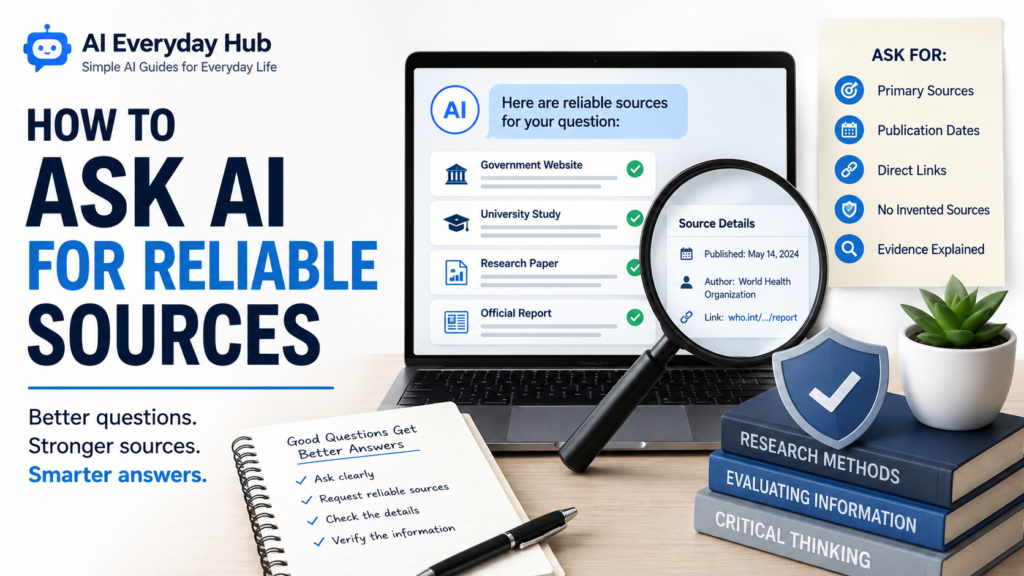
That is why learning How to Ask AI for Reliable Sources is an important skill for beginners.
Instead of simply asking AI a question and accepting the response, you can ask it to identify original sources, official documentation, research papers, government websites, or other trustworthy references.
However, asking AI for sources does not automatically make an answer accurate. AI systems can sometimes provide outdated, incorrect, or even nonexistent citations.
The goal is therefore not just to get sources.
The goal is to ask for better sources and then verify them.
In this guide, you will learn how to ask AI for reliable sources, what types of sources to request, how to write better source-focused prompts, and how to check whether the citations AI provides are trustworthy.
If you want to learn how to verify an entire AI response, read How to Check If an AI Answer Is Accurate.
How to Ask AI for Reliable Sources
The simplest approach is to tell AI exactly what type of evidence you want.
Instead of asking:
“Is this information correct?”
try:
“Answer this question using reliable sources. For each important factual claim, provide the source name, page title, publication date if available, and a link to the original source.”
This gives the AI clearer instructions.
You can make the request even stronger:
“Prioritize primary and authoritative sources such as government agencies, universities, original research papers, and official documentation. If you cannot find a reliable source for a claim, clearly say that you are uncertain instead of guessing.”
This does not guarantee perfect accuracy.
But it creates a much better starting point for verification.
Why Should You Ask AI for Sources?
Without sources, it can be difficult to determine where an AI-generated claim came from.
Suppose AI tells you:
“A recent study found that 72% of people prefer a particular technology.”
That sounds specific.
But several questions immediately arise:
- What study?
- Who conducted it?
- When was it published?
- How many people participated?
- Where can you read the original research?
- Did the study actually say 72%?
A source allows you to investigate those questions.
Without one, the statistic is simply an unsupported claim until you verify it independently.
Ask for Primary Sources First
One of the best ways to improve your research is to ask AI to prioritize primary sources.
Primary sources provide information directly from the organization or people responsible for it.
Depending on the topic, examples can include:
- Government agencies
- Original research papers
- Universities
- Official company documentation
- Product manuals
- Court documents
- Official statistics
- Regulatory agencies
- Original reports
For example, if you are researching a government program, ask AI to find the government agency responsible for that program rather than relying only on blogs discussing it.
Prompt Example
“Explain this government program using the responsible government agency as the primary source. Provide the exact page you used and identify any information that could not be confirmed from an official source.”
This makes your expectations clear.
Ask for the Original Source, Not Just Articles About It
Information is often copied from one website to another.
Imagine an AI tells you:
“A study found that AI improved productivity by 35%.”
You may find dozens of articles repeating that statistic.
But where did the number originate?
Ask:
“Find the original research or report behind the 35% statistic. Do not give me articles that only repeat the number.”
This helps you move closer to the original evidence.
Ask AI to Separate Claims and Sources
Long AI responses can contain many factual claims.
Instead of receiving a large list of links at the bottom, ask AI to match each important claim with its source.
Prompt Example
“Separate your answer into factual claims. Under each claim, provide the source that supports it.”
The response might then look like:
Claim 1: [Factual statement]
Source: [Original source]
Claim 2: [Factual statement]
Source: [Original source]
This structure makes verification much easier.
Ask for Publication Dates
A reliable source can still be outdated.
This matters especially for:
- AI tools
- Technology
- Software
- Laws
- Travel requirements
- Government programs
- Prices
- Product features
- Company policies
- Current events
Prompt Example
“Use sources published or updated within the last 12 months when possible. Include the publication or update date for each source.”
Then check those dates yourself.
For rapidly changing information, recent sources may be much more useful than older ones.
Ask AI to Distinguish Primary and Secondary Sources
Not every good source needs to be a primary source.
High-quality secondary sources can help explain complicated information.
But it is useful to know which type you are reading.
Prompt Example
“Give me two primary sources and two reputable independent secondary sources about this topic. Label each source as primary or secondary.”
This gives you different types of evidence to compare.
Ask for Independent Sources
Several sources are not necessarily better if they all repeat the same original claim.
You can specifically request independent confirmation.
Prompt Example
“Find two reliable independent sources that confirm this claim. Make sure one source is not simply repeating information from the other.”
You should still verify this yourself, but the instruction encourages a stronger research structure.
Ask AI Not to Invent Sources
This instruction is worth including when accuracy matters.
Prompt Example
“Do not invent citations, article titles, authors, studies, or URLs. If you cannot identify a verifiable source, say that you could not verify the claim.”
Again, a prompt cannot guarantee that AI will never make an error.
You still need to check the result.
But telling the AI how to handle uncertainty is better than encouraging it to produce an answer at all costs.
Ask for Direct Links
When possible, request a link to the actual source rather than only the organization’s homepage.
For example, instead of:
“Source: U.S. Census Bureau”
ask for the specific Census Bureau page or report supporting the claim.
Prompt Example
“Provide a direct link to the specific page, report, or document supporting each important claim, not just the organization’s homepage.”
Then open the link and confirm the content yourself.
Ask for Evidence, Not Just a Source List
A source can be real but still fail to support the AI’s claim.
Ask AI to explain the connection.
Prompt Example
“For each source, briefly explain exactly what information in that source supports your claim.”
This gives you something specific to check when you open the source.
Do not stop at the AI’s explanation, however.
Read the relevant part of the original source yourself.
Ask AI to Identify Uncertain Claims
A good research process should make uncertainty visible.
Try:
“Identify any claims in your answer that you are not confident can be verified from reliable sources.”
Or:
“Separate verified information from information that remains uncertain.”
This can make it easier to decide where you need additional research.
A Strong Source Request Prompt for Beginners
Here is a reusable prompt you can copy and adapt:
“Answer my question using reliable and verifiable sources. Prioritize primary sources such as government websites, universities, original research, and official documentation. For each important factual claim, provide the source name, page or report title, publication date when available, and direct link. Do not invent sources. If a claim cannot be verified, clearly label it as uncertain.”
You can add your question underneath.
For example:
“Question: What are the current benefits and limitations of electric vehicles in the United States?”
The same structure can be adapted to many topics.
A Prompt for Research Papers
If you are researching an academic topic, try:
“Find original peer-reviewed research related to this question. Give me the paper title, authors, journal, publication year, and DOI or official publication link when available. Do not invent citations.”
Then search for each paper independently.
Confirm that:
- The paper exists
- The authors are correct
- The journal is correct
- The publication year is correct
- The paper actually supports the claim
A Prompt for Government Information
For laws, programs, statistics, or regulations, you can ask:
“Use official government sources first. Identify the government agency responsible for this information and provide direct links to the relevant official pages.”
This can help you avoid relying on unofficial summaries when an authoritative source is available.
A Prompt for Product Information
Suppose you want to research a laptop.
Try:
“Use the manufacturer’s official documentation for technical specifications. Then provide two independent reputable sources for additional evaluation. Clearly separate official specifications from reviewer opinions.”
This is useful because product research often mixes objective facts with subjective recommendations.
A Prompt for Current Information
When information changes quickly, include a date requirement.
For example:
“Give me the most current information available as of today. Include the publication or last-updated date for each source and tell me if any important information may have changed.”
Current information still needs verification, but this instruction reminds the AI that freshness matters.
How to Check Whether an AI Source Is Real
Once AI gives you a citation, do not immediately trust it.
Open or search for the source.
Check:
- Does the page actually exist?
- Is the title correct?
- Is the author correct?
- Is the publication date correct?
- Does the URL lead to the claimed organization?
- Does the source actually contain the information?
If the AI cites a research paper, search for the paper independently through the journal, publisher, university, or a reputable scholarly search service.
If you cannot find the supposed source, treat it as unverified.
How to Evaluate the Source Itself
A real webpage is not automatically a reliable source.
Ask:
- Who created it?
- What organization is responsible?
- Does the author have relevant expertise?
- What evidence is provided?
- Is the information current?
- What is the purpose of the page?
- Do other reliable sources agree?
Google’s guidance for evaluating online information recommends investigating the source, looking for what other sources say about it, and checking the evidence behind claims.
What Are Signs of a Strong Source?
There is no single test that guarantees reliability, but stronger sources often have several useful characteristics.
They may:
- Clearly identify the author or organization
- Provide evidence
- Link to original data
- Explain research methods
- Show publication or update dates
- Correct errors transparently
- Have relevant expertise
- Be independently verifiable
The appropriate source also depends on the question.
For a company’s current product specifications, its official documentation may be the best primary source.
For an independent evaluation of that product, the company’s own marketing page would not be enough.
What Are Warning Signs?
Be cautious when a source:
- Does not identify an author or organization
- Makes extraordinary claims without evidence
- Uses statistics without identifying their origin
- Provides no publication date for time-sensitive information
- Copies information without linking to the original source
- Uses emotional headlines instead of evidence
- Makes claims that cannot be independently confirmed
One warning sign does not automatically prove that information is false.
It means you should investigate further.
Why AI Can Provide Fake Citations
AI-generated citations can sometimes look remarkably realistic.
An AI system may generate a plausible combination of:
- Author name
- Article title
- Journal name
- Publication year
- URL
But plausible is not the same as real.
This is related to the broader problem of AI hallucinations.
If you have not read it yet, see What Are AI Hallucinations? A Simple Beginner’s Guide.
The safest habit is simple:
Never cite an AI-provided source in your own work until you have confirmed that the source exists and supports the claim.
Ask AI to Help You Verify Its Own Answer
After receiving an initial answer, you can use a follow-up prompt.
For example:
“Now review your previous answer. List every factual claim that should be independently verified and show me the best type of source to use for each one.”
This turns AI into a research assistant rather than treating it as the final authority.
You can then perform the actual verification.
How Source Checking and Fact-Checking Work Together
Requesting sources is only the beginning.
After AI provides them, you still need to:
- Confirm the source exists.
- Open the original source.
- Check whether it supports the claim.
- Check the publication date.
- Investigate who created the source.
- Compare independent evidence.
For the complete process, read How to Fact-Check AI-Generated Information.
That guide explains how to move from an AI claim to a final evidence-based judgment.
AI Sources and AI Inference
Understanding how AI generates responses helps explain why source verification is necessary.
During inference, a trained AI model processes your input and generates an output based on learned patterns and available context.
A fluent response is not automatically a verified response.
For a beginner-friendly explanation of this process, read What Is AI Inference? A Simple Beginner’s Guide.
A Simple 5-Step Source Verification Routine
Beginners can use this routine whenever an AI provides an important source.
1. Open It
Confirm that the source exists.
2. Identify It
Determine who created or published it.
3. Read It
Check whether it actually supports the AI’s claim.
4. Date It
Make sure the information is current enough for your purpose.
5. Compare It
Look for independent reliable evidence.
Remember:
Source provided does not mean source verified.
When Reliable Sources Matter Most
You should be especially careful when AI-generated information could affect important decisions.
Examples include:
- Health
- Legal matters
- Financial decisions
- Taxes
- Safety
- Academic research
- Major purchases
- Travel requirements
In these situations, use appropriate authoritative sources and qualified professionals when necessary.
AI can help organize questions and explain terminology, but it should not automatically become your final authority.
Google’s Advice for Evaluating Online Information
Google provides guidance for evaluating information found online, including investigating the source, checking what other sources say, and examining the evidence behind a claim.
This is useful when AI gives you a webpage that you have never seen before.
Instead of trusting the page because it looks professional, investigate who is behind it and whether independent sources consider it credible.
Google’s guidance on evaluating information provides additional techniques you can use when checking AI-provided sources.
Why Beginners Should Learn This Skill
Learning How to Ask AI for Reliable Sources changes the way you use AI.
Instead of asking:
“Give me the answer.”
you begin asking:
“Give me the evidence so I can check the answer.”
That small change can make AI much more useful for research and everyday decision-making.
It also helps you recognize an important principle:
AI is a tool for assisting research, not a replacement for verification.
Final Thoughts
Knowing How to Ask AI for Reliable Sources is an important part of using artificial intelligence responsibly.
Ask AI to prioritize primary sources, provide direct links, identify publication dates, separate claims from evidence, and clearly acknowledge uncertainty.
Then verify the sources yourself.
The most useful habit to remember is:
Ask for the source. Open the source. Check the source.
AI can help you find information faster, but reliable evidence is what allows you to decide whether that information deserves your trust.