Introduction
Large Language Models, often called LLMs, are one of the most important technologies behind modern AI tools.
If you have used AI assistants like ChatGPT, Gemini, or other AI writing tools, you have already interacted with technology powered by Large Language Models.
Many beginners hear terms like AI, machine learning, deep learning, and LLMs, but these concepts can seem confusing.
The good news is that you do not need technical knowledge to understand the basic idea.
In simple terms, Large Language Models are AI systems designed to understand and generate human-like text by learning patterns from large amounts of information.
In this guide, you will learn what Large Language Models are, how they work, and why they are important in everyday AI applications.
What Are Large Language Models (LLMs)?
A Large Language Model is a type of artificial intelligence system that can understand and create text. Many generative AI tools rely on LLM technology to create new content.
The word “large” refers to the enormous amount of data and computing power used to train these models.
A language model learns patterns from examples of text, such as:
- Books
- Articles
- Websites
- Documents
- Other written information
After learning these patterns, the model can predict and generate text based on a user’s request.
For example, when you ask an AI tool:
“Explain artificial intelligence to a beginner.”
The model analyzes your request and creates a response based on what it has learned.
How Do Large Language Models Work?
Large Language Models work by identifying patterns in language.
They do not understand information exactly like humans do.
Instead, they analyze relationships between words, sentences, and ideas.
A simplified process looks like this:
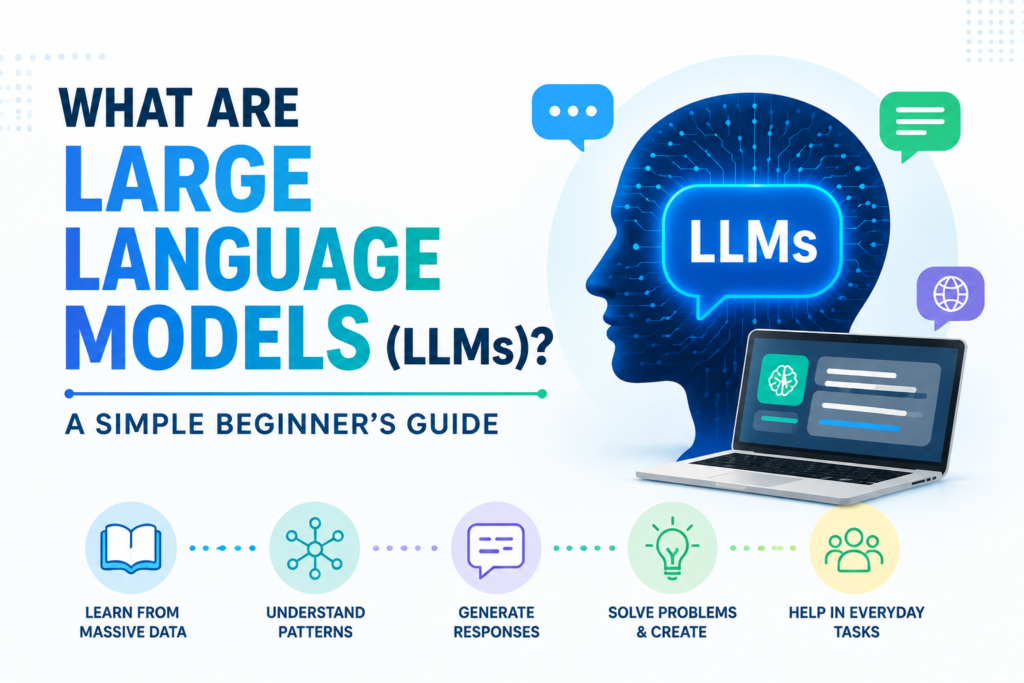
1. Training With Large Amounts of Data
During training, an LLM processes massive amounts of text.
The model learns:
- How words are connected
- How sentences are structured
- How information is commonly expressed
2. Learning Language Patterns
The model identifies patterns in the information it receives.
For example, it learns that certain words often appear together and that different types of questions require different types of answers.
3. Generating Responses
When a user enters a prompt, the model uses its learned patterns to create a response.
It predicts what information is most likely to be useful based on the request.
How Are LLMs Different From Traditional AI?
Traditional AI systems often rely on specific rules created by programmers.
For example:
A simple computer program might follow instructions like:
“If this happens, do this action.”
Large Language Models work differently.
They learn patterns from data instead of depending only on fixed rules.
This allows them to handle more flexible tasks, such as:
- Writing emails
- Summarizing information
- Answering questions
- Translating languages
- Creating ideas
What Is the Relationship Between AI, Machine Learning, and LLMs?
Many beginners confuse these terms.
The relationship can be understood like this:
Artificial Intelligence (AI)
↓
Machine Learning
↓
Deep Learning
↓
Large Language Models (LLMs)
AI is the broad concept.
Machine learning is one method used to create AI.
Deep learning is an advanced form of machine learning.
Large Language Models are specialized deep learning systems designed to work with language.
To understand the difference between AI and machine learning, read our guide: AI vs. Machine Learning: What’s the Difference?
To understand the difference between AI and machine learning, read our guide:
AI vs. Machine Learning: What’s the Difference?
Examples of AI Tools That Use LLMs
Many popular AI tools use Large Language Models.
Examples include:
ChatGPT
ChatGPT, developed by OpenAI, uses advanced language models to generate conversations, answer questions, and assist with writing.
Google Gemini
Gemini uses AI models designed to understand and generate text while working with different types of information.
AI Writing Tools
Many writing assistants use LLM technology to help users:
- Create content
- Improve writing
- Generate ideas
- Edit text
What Can Large Language Models Do?
Large Language Models can help with many everyday tasks.
Writing Assistance
LLMs can help create:
- Emails
- Blog ideas
- Reports
- Social media posts
Learning Support
Students and beginners can use AI tools to:
- Explain difficult topics
- Summarize information
- Practice new skills
Productivity
LLMs can help organize:
- Plans
- Lists
- Ideas
- Workflows
Creative Projects
Users can ask AI to help with:
- Stories
- Brainstorming
- Design ideas
- Content planning
Limitations of Large Language Models
Although LLMs are powerful, they are not perfect.
They can sometimes:
- Provide incorrect information
- Misunderstand questions
- Create outdated answers
- Produce information that needs verification
This is why users should always review important information before making decisions.
AI is a helpful tool, but human judgment is still important.
Why Should Beginners Understand LLMs?
Understanding Large Language Models helps you use AI tools more effectively.
When you understand how AI works, you can:
- Write better prompts
- Ask clearer questions
- Choose better AI tools
- Recognize AI limitations
You do not need to understand complex mathematics or programming.
A basic understanding of LLMs is enough to become a smarter AI user.
How LLMs Are Changing Everyday Life
Large Language Models are becoming part of many daily activities.
People use them for:
- Learning
- Writing
- Planning
- Research
- Communication
- Creativity
As AI technology continues to develop, understanding LLMs will become an increasingly useful skill.
Final Thoughts
Large Language Models are one of the key technologies behind today’s AI revolution.
They allow AI systems to understand and generate human-like text by learning patterns from massive amounts of information.
While LLMs are not human intelligence, they are powerful tools that can help people work, learn, and create more effectively.
By understanding what Large Language Models are and how they work, beginners can use AI tools with more confidence and better results.