
Some topics feel difficult not because you are incapable of learning them, but because the explanation starts in the wrong place.
A complicated subject may introduce unfamiliar vocabulary, assume background knowledge you do not have, connect several ideas at once, or explain an abstract concept without a useful example. When that happens, reading the same explanation again may not solve the problem.
AI gives you another option.
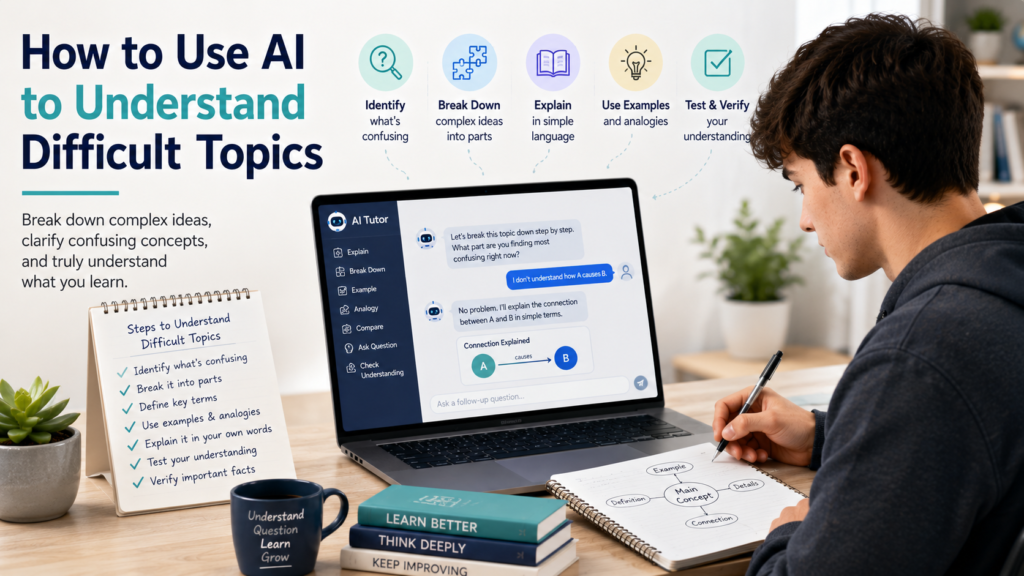
Learning how to use AI to understand difficult topics can help you break complex ideas into smaller pieces, define unfamiliar terms, simplify explanations, compare confusing concepts, create examples and analogies, and test whether you truly understand what you have learned.
The key is not simply asking AI to “explain this.” Instead, identify what is making the topic difficult and ask AI to address that specific problem.
Why Use AI to Understand Difficult Topics?
Different kinds of confusion require different solutions.
| When a Topic Feels Difficult | Better AI Approach |
|---|---|
| Too much information at once | Break it into smaller parts |
| Too many unfamiliar words | Define important terms first |
| Explanation is too technical | Lower the explanation level |
| Idea feels abstract | Give a concrete example |
| Two concepts seem similar | Compare them side by side |
| Individual parts make sense but the connection does not | Explain the relationship |
| One explanation is not working | Try a different explanation |
| You think you understand | Test your understanding |
| Important factual claims are involved | Verify them independently |
This flexibility is one of AI’s biggest advantages for learning.
You can keep changing the explanation until you discover where your understanding breaks down.
Step 1: Identify Exactly What Is Confusing
A common mistake is giving AI an enormous topic:
Explain quantum computing.
AI may respond with an enormous explanation—and now you have even more information to understand.
Instead, identify the problem.
Copy-and-Use Confusion Finder
I am trying to understand [TOPIC], but I am confused.
Before explaining it, help me identify exactly what I may be missing.
Ask me up to five short questions, one at a time, to determine:
- What I already understand
- Which terms are unfamiliar
- Which part of the concept is confusing
- Whether I am missing prerequisite knowledge
Do not begin a full explanation until you identify the likely source of confusion.
This changes the task from “teach me everything” to “find the obstacle.”
Step 2: Ask AI to Break the Topic Into Smaller Parts
Large topics become easier when you can see their components.
Suppose you are trying to understand inflation.
Instead of requesting one long explanation, ask:
Break inflation into the 5 most important ideas a beginner needs to understand. Show me the parts first without explaining them in detail. Then start with Part 1 only.
AI might identify:
- What inflation means
- How inflation is measured
- Why prices can rise
- How inflation affects purchasing power
- How governments and central banks respond
Now you are dealing with one learning problem at a time.
This approach is also used in OpenAI’s Study Mode, which can break larger subjects into smaller sections and begin with simpler explanations before adding complexity.
Step 3: Find the Prerequisite Knowledge You Are Missing
Sometimes the difficult topic is not actually the problem.
You may be missing something that comes before it.
Imagine trying to understand compound interest without being comfortable with percentages.
Or trying to understand machine learning without knowing what an algorithm is.
Ask:
Prerequisite Check
I want to understand [DIFFICULT TOPIC].
List the essential concepts I should already understand first.
For each prerequisite, ask me one quick question to check whether I understand it.
If I am missing something important, teach that prerequisite before returning to the main topic.
This prevents you from repeatedly struggling with an advanced explanation when the real gap is somewhere earlier.
Step 4: Define Technical Terms Before Using Them
Technical vocabulary can make a simple idea feel much more difficult.
Suppose an explanation says:
A neural network uses weighted connections between artificial neurons and adjusts parameters through optimization.
A beginner may now need to understand:
- Neural network
- Weighted connection
- Artificial neuron
- Parameter
- Optimization
before understanding the original sentence.
Tell AI to control the vocabulary.
Quick Definition Prompt
Explain [TOPIC] for a beginner. Before using an important technical term, define it in plain English. Keep a short glossary of the terms I need to remember.
You can also ask:
Rewrite the explanation using ordinary language first. Then show me the technical terms that correspond to those ideas.
This lets you understand the idea before memorizing its terminology.
Step 5: Lower the Explanation Level
If an explanation feels too difficult, you do not necessarily need a different source.
You may simply need a different level.
Try asking AI to create layers:
Explain [CONCEPT] at three levels:
Level 1: One-sentence explanation
Level 2: Beginner explanation with no assumed background knowledge
Level 3: More detailed explanation using the correct technical terminologyLet me stop and ask questions between levels.
Start with the simplest version.
Then add complexity only when the foundation makes sense.
Step 6: Use Quick Commands When You Get Stuck
You do not need to write a new detailed prompt every time something becomes confusing.
Keep these commands available during the conversation.
Quick Commands for Difficult Topics
Simplify: Explain this at a beginner level without removing the essential idea.
Define: Define every important technical term before using it.
Example: Give me one concrete example.
Break Down: Divide this concept into smaller parts and explain only Part 1 first.
Slow Down: Explain one step at a time and wait for me before continuing.
Compare: Compare [CONCEPT A] and [CONCEPT B] side by side.
Connection: I understand [A] and [B] separately, but not how they connect. Explain only the connection.
Different Approach: The previous explanation did not help me. Explain the same idea using a different approach.
Check Me: Ask me one question that will reveal whether I actually understand this concept.
This compact format also makes it easy to save the commands and reuse them with other subjects.
Step 7: Ask for a Concrete Example
Abstract concepts often become understandable when you see them working in a specific situation.
Suppose you are learning opportunity cost.
A definition may not be enough.
Ask:
Give me one simple everyday example of opportunity cost involving a decision between two things. Walk me through exactly where the opportunity cost appears.
Then change the example:
Now give me a different example involving money.
Then:
Give me an example where people commonly misunderstand opportunity cost.
Multiple examples help you separate the underlying concept from one particular scenario.
Step 8: Ask for an Analogy—Then Check Its Limits
Analogies can make difficult topics easier to visualize.
For example, AI might compare computer RAM to a desk:
- The desk represents temporary working space.
- Items currently being used stay on the desk.
- A larger desk lets you work with more items at once.
That can be helpful, but analogies are simplifications.
Use:
Explain [CONCEPT] using a familiar everyday analogy. After the analogy, tell me which parts are accurate and where the analogy stops matching the real concept.
That last sentence is important.
Otherwise, you may accidentally learn the analogy instead of the actual concept.
Step 9: Compare Similar Concepts Side by Side
Confusion often comes from two concepts that seem almost identical.
Examples include:
- Weather vs. climate
- RAM vs. storage
- Revenue vs. profit
- Correlation vs. causation
- Machine learning vs. artificial intelligence
- Saving vs. investing
Instead of requesting separate definitions, compare them directly.
Copy-and-Use Comparison Prompt
Compare [CONCEPT A] and [CONCEPT B] for a beginner.
Use a table with:
- Simple definition
- Main purpose
- Key difference
- One example
- Common confusion
After the table, give me three short scenarios and ask me to identify which concept applies.
Now you learn both the definitions and the boundary between them.
Step 10: Ask AI to Explain the Connection Between Ideas
Sometimes you understand A.
You understand B.
But you do not understand why A leads to B.
That is a different learning problem.
For example:
I understand that interest rates can rise, and I understand that borrowing can decrease. What I do not understand is why higher interest rates can reduce borrowing. Explain only the connection between those two ideas.
This is often more effective than asking AI to explain the entire subject again.
Use:
I understand [A] and [B] separately. Explain the causal or logical connection between them step by step. Do not explain unrelated parts of the topic.
This targets the missing bridge.
Step 11: Keep Asking “Why?” Until You Reach the Missing Idea
Difficult topics sometimes contain hidden assumptions.
Consider:
Higher interest rates can reduce borrowing.
Ask:
Why?
AI explains.
Then ask:
Why does that happen?
Continue until you reach the part that was actually confusing.
You can make this more structured:
Explain why [CLAIM] is true. After each step, identify what fact or principle that step depends on. Stop when you reach a basic principle I already understand.
This helps expose the chain of reasoning rather than giving you another conclusion to memorize.
Step 12: Build the Explanation Back Up
After breaking a difficult topic into pieces, reconnect them.
Suppose you separately learned:
- What a cell is
- What DNA is
- What a gene is
- What a protein is
Now ask:
I understand these four ideas separately: [LIST CONCEPTS]. Connect them into one coherent explanation. Show the relationship in a simple sequence, then explain the sequence in a short paragraph.
You might get a structure such as:
DNA → Genes → Instructions → Proteins → Cell Functions
The goal is to rebuild the big picture after understanding the pieces.
Step 13: Ask AI to Show the Process Visually in Text
Some ideas are easier to understand as a sequence than as paragraphs.
Ask:
Show this process as a simple text flow using arrows. Keep each step to a few words. Then explain each transition underneath.
For example:
Income → Spending → Saving → Investing → Potential Growth
Or:
Question → Evidence → Analysis → Conclusion
This is particularly useful for:
- Processes
- Cause-and-effect relationships
- Timelines
- Systems
- Decision paths
The visual sequence gives you a mental map before the detailed explanation.
Step 14: Explain the Difficult Topic Back to AI
Now stop asking AI to explain.
You explain.
Teach-It-Back Prompt
I am going to explain [TOPIC] in my own words.
Do not rewrite my explanation immediately.
Evaluate it for:
- What I understand correctly
- What is incomplete
- What is inaccurate
- Where my reasoning becomes unclear
Then ask me one question about the weakest part and let me try again.
This is one of the best ways to discover hidden gaps.
An explanation can feel perfectly clear while you are reading it. Trying to reproduce it from memory is much harder.
Step 15: Test Understanding With a New Situation
Memorizing an example does not prove that you understand the concept.
Ask AI to change the situation.
For example:
Give me a new scenario where the same concept applies, but do not tell me how. Ask me to identify the concept and explain my reasoning.
If you can recognize and apply the idea in a different situation, your understanding is becoming more flexible.
You can gradually increase difficulty:
| Level | Test |
|---|---|
| 1 | Define the concept |
| 2 | Explain it in your own words |
| 3 | Recognize an example |
| 4 | Compare it with another concept |
| 5 | Apply it to a new situation |
| 6 | Explain why it applies |
| 7 | Identify an exception or limitation |
You do not need to reach Level 7 for every everyday topic.
But moving beyond simple recognition helps reveal whether you truly understand it.
Step 16: Ask AI to Find the Exact Gap in Your Answer
When you answer incorrectly, do not immediately request the solution.
Use:
Find-My-Gap Prompt
Here is my understanding:
[WRITE YOUR EXPLANATION OR ANSWER]
Do not give me a complete replacement answer yet.
Identify the earliest point where my reasoning becomes incorrect or incomplete.
Explain only that gap and give me one hint.
Then let me revise my answer.
This keeps you actively involved.
The objective is not for AI to produce a perfect explanation.
It is for you to repair your own understanding.
Step 17: Ask AI to Challenge Your Understanding
Once something begins to make sense, try to break your own understanding.
Ask:
Give me three statements about [TOPIC]:
- One clearly correct
- One clearly incorrect
- One that sounds reasonable but contains a subtle mistake
Do not tell me which is which. Let me identify them and explain my reasoning.
This is especially useful when a topic contains common misconceptions.
Another useful version is:
Give me a common misconception about this topic without telling me why it is wrong. Let me identify the problem first.
Now you are practicing discrimination rather than passive recognition.
Step 18: Use AI as a Personal Tutor When You Need More Guidance
Sometimes a difficult topic cannot be solved with one explanation.
You may need several rounds of teaching, questions, practice, and feedback.
In that situation, switch from individual questions to a tutoring structure.
Tell AI:
Act as my tutor for this topic. Teach one concept at a time, ask me questions, give hints before answers, and do not move forward until my responses show that I understand the current concept.
For a complete reusable tutoring system, How to Use AI as a Personal Tutor shows how to set tutor rules, assess your starting level, use hints, analyze mistakes, adjust difficulty, track weak areas, and end each session with a learning review.
Step 19: Use AI to Understand Your Own Learning Materials
The difficult explanation may already be sitting in front of you.
You might have:
- Class notes
- A textbook section
- Instructions
- A technical document
- Presentation slides
- A research paper
- A diagram
- A worksheet
When your AI tool supports files or images, provide the relevant material and identify the exact section causing trouble.
Use:
Explain-My-Material Prompt
I am trying to understand the material I provided.
Focus only on [PAGE / SECTION / PARAGRAPH / CONCEPT].
First identify the main idea.
Then:
- Define unfamiliar terminology.
- Explain the idea in simpler language.
- Show how it connects to the surrounding material.
- Give one example if useful.
- Ask me one question to check my understanding.
Clearly distinguish between information contained in my material and additional explanation you provide.
OpenAI’s Study Mode can work with uploaded notes, slides, readings, worksheets, images, and other study materials when file uploads are available.
Step 20: Verify Important Explanations
A simpler explanation is not automatically a correct explanation.
AI can misunderstand a question, oversimplify a concept, omit an important exception, or confidently provide incorrect information.
That means understanding and verification are separate steps.
Ask:
Identify the most important factual claims in this explanation that I should verify. For each one, tell me what type of authoritative source would be appropriate.
Then check important claims against appropriate sources such as:
- Official documentation
- Government agencies
- Academic institutions
- Textbooks
- Original research
- Professional organizations
- Primary sources
This becomes especially important for health, financial, legal, scientific, historical, and other consequential topics.
How to Check If an AI Answer Is Accurate provides a complete process for evaluating claims, checking sources, and recognizing information that needs additional verification.
OpenAI also warns that Study Mode can make mistakes and recommends double-checking important information, particularly for high-stakes topics.
Step 21: Know When AI Is Not Enough
AI is useful for changing how information is explained.
It is not always the right final source.
If you still cannot understand a concept after several attempts, you may need:
- A textbook with diagrams
- A demonstration
- A video
- A teacher
- A tutor
- An expert
- Hands-on practice
- A structured course
You can ask AI:
I am still struggling with [CONCEPT] after trying several explanations. Identify what type of learning resource might help next and explain why.
Sometimes the problem is not the explanation.
You may need to see, practice, discuss, or experience the concept differently.
A Complete Difficult-Topic Prompt You Can Reuse
Here is one prompt you can save for future use.
I want to understand [DIFFICULT TOPIC].
What I already understand:
[DESCRIBE WHAT YOU KNOW]What is confusing me:
[DESCRIBE THE CONFUSING PART]My current level:
[BEGINNER / INTERMEDIATE / ADVANCED]Help me understand the topic using this process:
- Identify any prerequisite knowledge I may be missing.
- Break the difficult concept into smaller parts.
- Define important technical terms before using them.
- Explain the first part in simple language.
- Give one concrete example.
- Use an analogy only if it genuinely helps, and explain its limitations.
- Ask me one open-ended question to check my understanding.
- Wait for my response before continuing.
- If my answer is wrong, identify the gap and give me a hint before giving the complete answer.
- Gradually reconnect the smaller parts into the complete concept.
- Give me a new scenario where I must apply the idea.
- Tell me which important factual claims should be independently verified.
Do not overwhelm me with the entire topic at once. Teach one important piece at a time.
The prompt is useful because it gives AI a method for explaining, not merely a topic.
Example: Understanding a Difficult Concept With AI
Imagine you are trying to understand correlation and causation.
A weak starting prompt would be:
Explain correlation and causation.
You may receive definitions that are technically correct but still confusing.
A better process begins with:
I understand that correlation means two things are related somehow, but I do not understand why correlation does not prove that one caused the other. Explain only that difference using a simple everyday example.
After the explanation:
Give me three situations. Do not tell me whether they show correlation or causation. Let me decide and explain why.
Then:
My answer is [ANSWER]. Identify the first problem in my reasoning without giving me the complete explanation.
Finally:
Now ask me to explain the difference between correlation and causation in my own words.
Notice what happened.
AI did not simply generate more information.
It helped isolate the confusion, explain the missing relationship, provide practice, diagnose a mistake, and test understanding.
That is a much more useful way to use AI to understand difficult topics.
Common Mistakes When Using AI for Difficult Topics
| Common Mistake | Better Approach |
|---|---|
| Asking for the entire topic at once | Break it into smaller parts |
| Saying only “I don’t understand” | Identify the confusing point |
| Ignoring prerequisite knowledge | Check what comes before the topic |
| Accepting unexplained terminology | Define terms first |
| Repeating the same explanation | Request a different approach |
| Treating an analogy as literal truth | Ask where the analogy fails |
| Memorizing one example | Apply the concept to a new situation |
| Reading without testing yourself | Explain it back |
| Asking for solutions immediately | Identify the gap and use hints |
| Assuming a clear answer is correct | Verify important claims |
A Simple Learning Loop for Difficult Topics
When you get stuck, use this sequence:
Find the confusion → Break it down → Define terms → Simplify → Example → Connect ideas → Explain it yourself → Practice → Find gaps → Verify
If one stage fails, return to it.
For example, if you cannot explain the concept yourself, do not automatically restart the entire lesson.
Ask:
Which specific part of my explanation shows that I am still confused?
Then focus only on that part.
This makes the learning process more efficient and prevents you from repeatedly rereading information you already understand.
Use AI to Understand Difficult Topics Without Avoiding the Difficulty
There is an important balance.
AI should make a difficult topic more understandable, but it should not remove every moment of effort.
If AI explains everything, answers every question, solves every problem, and corrects every mistake before you have a chance to think, the conversation may feel easy without producing much learning.
OpenAI’s official Study Mode guidance describes a learning approach based on guiding questions, layered explanations, knowledge checks, feedback, and step-by-step reasoning rather than simply supplying final answers.
The productive version looks more like:
AI explains → You think → You answer → AI identifies a gap → You try again
The objective is not to make difficult topics look easy.
It is to make them possible to work through.
Final Takeaway
Learning how to use AI to understand difficult topics begins with recognizing that “I don’t understand” is only the starting point.
Find out what is actually causing the confusion.
Is the topic too large? Are unfamiliar terms getting in the way? Are you missing prerequisite knowledge? Do you understand the individual ideas but not their relationship? Is the explanation too abstract?
Once you identify the problem, use AI deliberately.
Break the topic into smaller pieces. Define technical language. Lower the explanation level. Request concrete examples. Use analogies carefully. Compare similar concepts. Ask AI to explain missing connections and challenge you with new situations.
Then stop asking AI to explain and start explaining the topic yourself.
Your mistakes will show you where to return.
Finally, verify important factual information with authoritative sources instead of assuming that a clear AI explanation must be correct.
A difficult topic does not always need more information.
Sometimes you simply need the same idea presented at the right level, in the right order, with the right example—and enough opportunity to think through it yourself.