
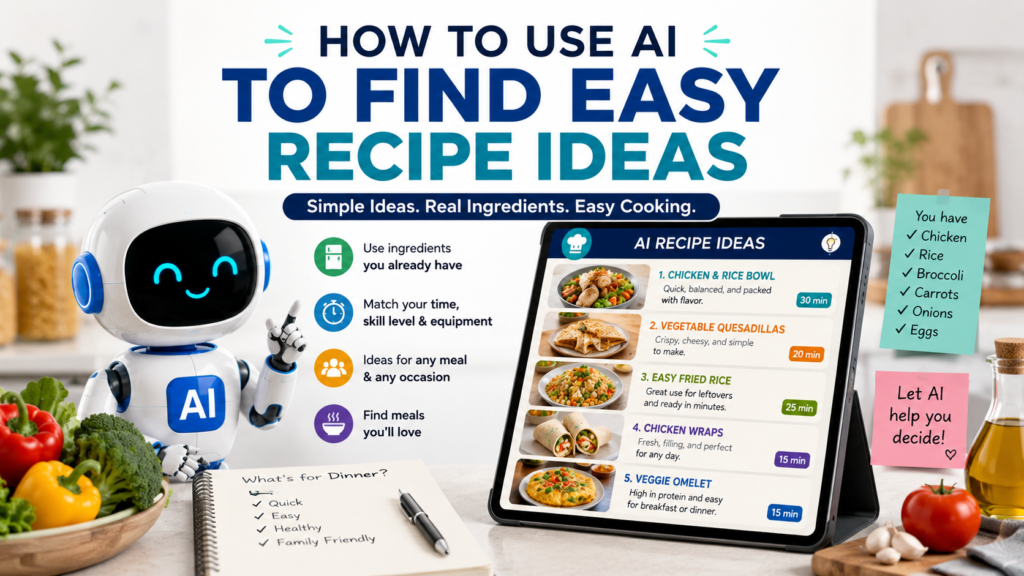
Finding something easy to cook can sometimes take longer than cooking the meal itself. You open the refrigerator, see a few ingredients, and still cannot decide what to make. Or you find an interesting recipe online only to discover that it requires too many ingredients, too much preparation, or equipment you do not have.
One practical solution is to use AI to find easy recipe ideas. Instead of searching through dozens of recipes, you can tell an AI assistant what ingredients you have, how much time you want to spend cooking, how many people you are feeding, and what kinds of meals you enjoy.
AI can then suggest several possibilities that match those conditions.
The important thing is to treat those suggestions as ideas rather than automatically assuming every AI-generated recipe is accurate. Once you find an idea you like, review the ingredients and cooking instructions before preparing it.
Here is a simple way to get started.
Why Use AI to Find Easy Recipe Ideas?
Traditional recipe searches usually begin with the name of a dish.
But sometimes you do not know what dish you want.
You may only know:
- You have chicken and vegetables.
- You need dinner in 30 minutes.
- You do not want to use the oven.
- You are cooking for two people.
- You want something simple.
- You would rather use ingredients already at home.
That type of situation works well for AI brainstorming.
For example:
I have chicken breasts, rice, carrots, onions, eggs, and frozen broccoli. Give me five simple dinner ideas using mostly these ingredients.
Instead of choosing a recipe first and then buying everything it requires, you are starting with your actual situation.
If you want to organize recipe ideas across several days rather than choose just one meal, How to Use AI to Plan Meals for the Week explains how to turn individual meal ideas into a weekly plan.
Step 1: Tell AI What Ingredients You Already Have
One of the easiest ways to start is with your refrigerator and pantry.
You do not need to list everything you own.
Focus on the ingredients you would like to use.
For example:
I have eggs, spinach, tomatoes, cheese, tortillas, rice, and canned beans. Suggest five easy meals that use several of these ingredients.
AI might suggest possibilities such as:
- Vegetable quesadillas
- Egg and spinach wraps
- Rice and bean bowls
- Tomato and cheese omelets
- Simple bean tacos
At this stage, you are looking for ideas, not detailed recipes.
That distinction helps keep the response short and easy to evaluate.
Step 2: Tell AI How Much Time You Have
“Easy” means different things to different people.
A recipe that takes 45 minutes may feel easy on Sunday but completely unrealistic on a busy Tuesday evening.
Give AI a time limit.
For example:
I have about 20 minutes to make dinner. Suggest five meal ideas using eggs, tortillas, cheese, spinach, and tomatoes.
Or:
Give me three dinner ideas that require no more than 15 minutes of active preparation.
Be specific about whether you mean total cooking time or hands-on preparation time.
A slow-cooker meal, for example, may require very little active work but several hours of cooking.
Step 3: Tell AI Your Cooking Skill Level
AI may describe a recipe as simple even though it includes techniques you have never used.
Tell it what level of cooking you want.
For example:
I am a beginner cook. Suggest meals that use basic techniques such as boiling, baking, sautéing, or assembling ingredients. Avoid complicated techniques.
You can make the request even more specific:
Assume I know how to cook pasta, scramble eggs, use a skillet, and use an oven, but I do not have advanced cooking skills.
This helps AI understand what “easy” means for you.
Step 4: Tell AI What Equipment You Have
A recipe is not very useful if it requires equipment you do not own.
You might say:
I have a stove, oven, microwave, skillet, saucepan, and basic kitchen tools. I do not have an air fryer, slow cooker, or food processor.
Or perhaps you specifically want to use one appliance:
Give me four easy dinner ideas that can be made primarily in one skillet.
Other useful constraints include:
- One pot
- One pan
- Microwave
- Oven only
- No oven
- Slow cooker
- Air fryer
Providing this information can eliminate many unsuitable suggestions before they appear.
Step 5: Tell AI How Many People You Are Feeding
Serving size matters.
Tell AI whether you are cooking for:
- One person
- Two adults
- A family
- Adults and children
- A larger group
For example:
Suggest four easy dinners for two adults using chicken, rice, frozen vegetables, and eggs.
At the idea stage, exact quantities may not be necessary.
Once you select a recipe, you can ask AI to adapt it to your serving size.
Step 6: Add Foods You Like and Dislike
A technically easy recipe is useless if nobody wants to eat it.
Tell AI about important preferences.
For example:
We like pasta, tacos, rice bowls, chicken, and simple vegetable dishes. We do not like mushrooms or very spicy food.
Or:
Suggest familiar, mild meals that would work for a family dinner.
You do not need to describe every food preference you have. Include the ones most likely to affect the suggestions.
If you find yourself getting generic or irrelevant answers, How to Write AI Prompts: A Simple Beginner’s Guide can help you give AI clearer instructions and useful context.
Weak Prompt vs. Better Prompt
Weak Prompt
Give me an easy recipe.
This leaves almost everything undefined.
AI does not know:
- What ingredients you have
- How much time you have
- How many people you are feeding
- Your cooking experience
- Your available equipment
- What foods you like
The answer may still be usable, but it is largely based on assumptions.
Better Prompt
Give me five easy dinner ideas for two adults. I have chicken breasts, rice, frozen broccoli, carrots, eggs, onions, and basic pantry staples. I have about 30 minutes and want to use only a skillet and saucepan. I am a beginner cook, and I prefer simple, mild meals. Start with meal ideas and short descriptions only, not full recipes.
This gives AI clear boundaries.
OpenAI’s prompting guidance recommends being clear and specific and providing enough context about what you want, then refining the result through follow-up requests when needed.
Step 7: Ask for Several Ideas Before Asking for a Recipe
You do not need a complete recipe for every suggestion.
That can create too much information.
Start with:
Give me five meal ideas with a one-sentence description of each. Do not provide recipes yet.
Review the options.
Then choose one:
I like idea #3. Give me a simple recipe for that meal for two people.
This two-step approach is often easier than asking AI to generate five complete recipes and then reading through all of them.
Step 8: Ask AI to Compare Two Recipe Ideas
Sometimes two options sound good.
Ask AI to help you compare them.
For example:
Compare the chicken rice bowl and chicken pasta ideas. Which one is likely to require fewer ingredients and less active preparation? Explain briefly.
Or:
Which of these three meal ideas makes the best use of the ingredients I already have?
Remember that AI may estimate preparation time or difficulty incorrectly.
Use the comparison to narrow your options, then review the selected recipe yourself.
Step 9: Ask AI to Simplify a Recipe
Perhaps you find a recipe idea you like, but the instructions are too complicated.
Tell AI:
Simplify this recipe for a beginner. Reduce unnecessary steps and use common ingredients when possible.
You can also say:
This recipe uses too many ingredients. Suggest a simpler version using no more than eight main ingredients.
Or:
Keep the basic idea, but turn it into a one-pan meal if practical.
AI is often useful for adapting an idea to your preferred level of effort.
Step 10: Ask for Substitution Ideas
You may like a recipe but be missing one ingredient.
Instead of abandoning the idea, ask:
This recipe calls for spinach, but I do not have any. I have frozen broccoli and carrots. Would either work as a practical substitute?
For ordinary cooking preferences, AI can help brainstorm alternatives.
However, substitutions involving food allergies, medical dietary restrictions, or food safety require more care. Do not assume that an AI-suggested substitute is automatically safe for someone with a serious allergy or medical condition.
Step 11: Use AI to Find Ideas for Leftovers
Leftovers can become useful starting points.
Suppose you have cooked chicken and rice from yesterday.
Try:
I have leftover cooked chicken and rice. Give me five easy ideas for turning them into a different meal. I also have eggs, frozen vegetables, tortillas, cheese, and basic sauces.
This might lead to ideas such as:
- Chicken fried rice
- Chicken quesadillas
- Rice bowls
- Chicken wraps
- Simple chicken-and-rice soup
This can help reduce the feeling that leftovers must be eaten exactly the same way again.
Step 12: Ask AI for Ideas Based on One Ingredient
Sometimes you have one ingredient that needs to be used soon.
For example:
I have several tomatoes that I need to use. Give me six easy meal ideas that use tomatoes along with common pantry ingredients.
Or:
I have a package of chicken breasts that needs to be cooked today. Suggest five beginner-friendly dinner ideas.
This is a simple way to brainstorm possibilities without searching for a specific recipe name.
Step 13: Turn a Recipe Idea Into a Grocery List
Once you select a recipe, check what you already have.
Then identify what is missing.
For example:
Here is the recipe I chose. I already have chicken, rice, onions, olive oil, salt, and pepper. Tell me only which ingredients I still need to buy.
If you are shopping for several meals rather than one recipe, How to Use AI to Create a Grocery List explains how to combine ingredients, remove duplicates, and organize everything into a practical shopping list.
Keeping recipe discovery and grocery planning as separate steps makes the process easier to review.
A Reusable Prompt for Easy Recipe Ideas
Here is a template you can reuse:
Help me find easy recipe ideas.
People I am feeding:
[Number]Ingredients I already have:
[List ingredients]Cooking time available:
[Time]Cooking skill level:
[Beginner / intermediate / other]Equipment available:
[Stove, oven, microwave, skillet, etc.]Foods we like:
[Preferences]Foods to avoid:
[Optional]Give me five simple meal ideas that fit these conditions. Use ingredients I already have when practical. Start with meal names and short descriptions only. Do not give me full recipes until I choose one.
You do not need to complete every section.
Use only the details that matter for your situation.
Practical Example: “What Can I Make Tonight?”
Imagine it is 5:30 p.m.
You have:
- Chicken breasts
- Rice
- Eggs
- Frozen broccoli
- Carrots
- Onions
- Tortillas
- Cheese
You want dinner ready without a complicated cooking project.
Instead of searching for random recipes, ask:
I need dinner ideas for two adults. I have chicken breasts, rice, eggs, frozen broccoli, carrots, onions, tortillas, and cheese. I have about 30 minutes, I am a beginner cook, and I want to use a skillet and saucepan only. Give me five simple options. Do not provide full recipes yet.
Suppose AI suggests:
- Chicken and vegetable rice bowls
- Chicken quesadillas
- Simple chicken fried rice
- Chicken and vegetable wraps
- Egg and vegetable rice bowls
You choose #3.
Then ask:
Give me a beginner-friendly recipe for option #3 for two adults. Use the ingredients I listed and basic pantry staples only. Keep the instructions simple.
After receiving the recipe, review it.
If it seems too complicated:
Simplify the recipe further and reduce the number of steps.
If you are missing an ingredient:
I do not have that ingredient. Suggest a practical alternative from the foods I already listed.
This conversational approach gives you much more control than asking AI to decide everything at once.
Common Mistakes When Using AI for Recipe Ideas
Asking for a Recipe Before Defining “Easy”
Tell AI what easy means to you.
It could mean:
- Under 20 minutes
- Five ingredients
- One pan
- Beginner-friendly
- Minimal cleanup
- No special equipment
The more specific you are, the more useful the ideas can become.
Providing Too Few Details
If you only say “give me dinner ideas,” AI has to make many assumptions.
Include the most important constraints.
Requesting Too Many Full Recipes
Start with several short ideas.
Choose one before asking for detailed instructions.
Letting AI Invent Ingredients You Do Not Have
If using existing ingredients is important, say:
Prioritize the ingredients I listed and clearly identify anything additional I would need.
Assuming Cooking Times Are Exact
Cooking time depends on equipment, ingredient size, preparation, experience, and other factors.
Treat AI estimates as approximate.
Assuming Every AI Recipe Is Reliable
AI can produce incorrect quantities, unclear instructions, or unsafe cooking guidance.
Review the recipe before using it.
Check Important Food-Safety Information
Recipe brainstorming is a low-risk use of AI, but food safety deserves more care.
An AI assistant can make mistakes about cooking temperatures, storage times, reheating, or handling raw ingredients.
For meat, poultry, seafood, eggs, leftovers, and other potentially hazardous foods, verify important safety information using an authoritative source.
The USDA Food Safety and Inspection Service provides official safe minimum internal temperature guidance for commonly prepared foods.
For example, do not rely on an AI-generated statement about whether poultry is safely cooked simply because the recipe sounds confident.
Use a food thermometer where appropriate and follow established food-safety guidance.
Be Especially Careful With Food Allergies
If someone has a serious food allergy, AI should not be your only source for deciding whether an ingredient, substitution, or packaged food is safe.
AI may overlook:
- Hidden ingredients
- Cross-contact risks
- Product formulation changes
- Different ingredient names
- Preparation risks
Check actual food labels and appropriate professional or official guidance.
Convenience should never replace verification when safety is involved.
Use AI for Inspiration, Not Automatic Authority
AI is particularly useful when the problem is:
“I have these ingredients. What could I make?”
It can quickly generate possibilities that you may not have considered.
But you still decide:
- Whether the meal sounds good
- Whether you have the necessary ingredients
- Whether the recipe matches your skills
- Whether the cooking instructions make sense
- Whether quantities are realistic
- Whether food-safety information needs verification
Think of AI as a brainstorming partner in the kitchen.
It can help you get past the question of “What should I make?” while leaving the final decisions to you.
Final Takeaway
Learning how to use AI to find easy recipe ideas can make everyday cooking decisions faster and less frustrating.
Start by telling AI what ingredients you already have. Then add the information that makes a recipe easy for you: available cooking time, number of people, skill level, equipment, and food preferences.
Ask for several short ideas first.
Once you find one that sounds good, request the full recipe, simplify it if necessary, and identify any missing ingredients.
Most importantly, review AI-generated cooking instructions before using them and verify important food-safety information from authoritative sources.
Used this way, AI can help turn a few ingredients and an empty dinner plan into practical meal ideas without making the process more complicated than the meal itself.