
Introduction
AI can explain complicated topics, but sometimes the first explanation is still too difficult to understand.
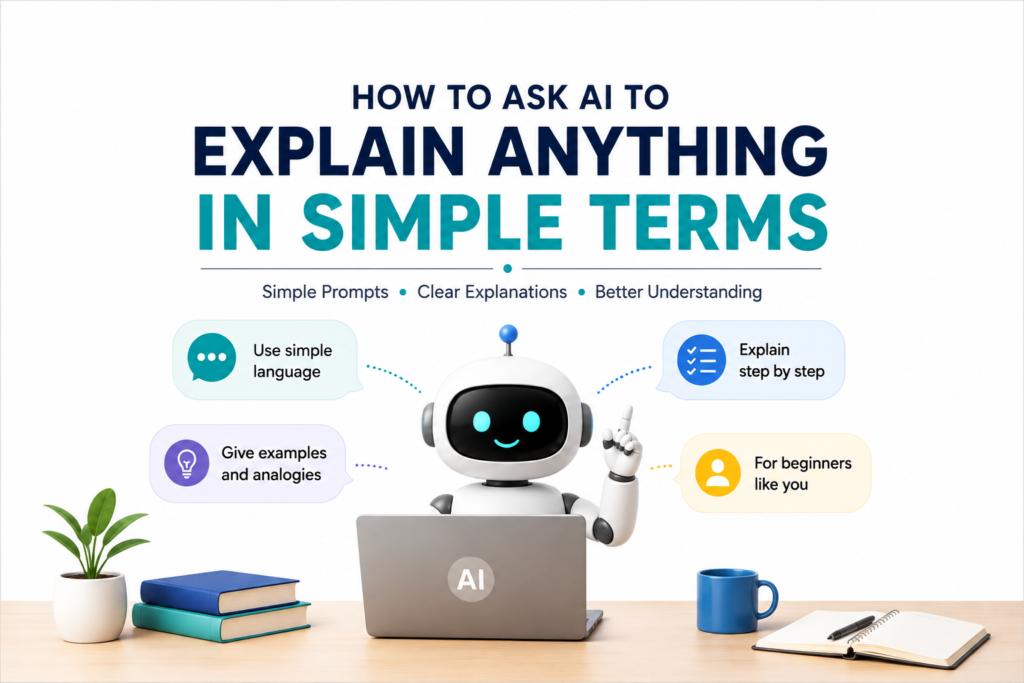
Learning how to ask AI to explain anything in simple terms can turn confusing information into clear, beginner-friendly explanations. You can ask AI to explain something in simple terms by avoiding technical language, defining unfamiliar words, providing everyday examples, using analogies, or breaking a topic into simple steps.
You do not need to understand a complicated subject before asking about it.
You simply need to tell AI what you already know, what you do not understand, and how simple you want the explanation to be.
This guide will show you practical prompts you can use to make difficult topics easier to understand.
How to Explain Anything in Simple Terms With AI
Traditional explanations are often written for people who already understand the basics.
You may encounter:
- Technical terminology
- Complicated definitions
- Long explanations
- Unfamiliar abbreviations
- Concepts that assume previous knowledge
AI gives you the ability to adjust an explanation to your level.
Instead of repeatedly searching for easier articles, you can say:
“Explain this in simple terms for a complete beginner.”
Then continue asking questions until the explanation makes sense.
1. Tell AI You Are a Beginner
One of the simplest techniques is to tell AI your knowledge level.
Instead of:
“What is cloud computing?”
Try:
“Explain cloud computing to a complete beginner who has no technical background.”
This tells AI not to assume that you already understand computer terminology.
You can use similar instructions for almost any subject:
“Explain this to someone learning about it for the first time.”
“Assume I know nothing about this topic.”
“Start with the basics before explaining the details.”
These small instructions can significantly change the complexity of an AI response.
2. Ask AI to Use Everyday Language
Sometimes an explanation is difficult because it contains too much specialized vocabulary.
One easy way to explain anything in simple terms is to ask AI to replace specialized language with words you already know.
Ask AI directly:
“Explain this using everyday language.”
You can also say:
“Avoid technical jargon. If you must use a technical term, explain what it means.”
For example:
“Explain inflation using everyday language and avoid economic terminology unless you define it.”
This encourages AI to translate specialized concepts into more familiar language.
3. Ask for an Everyday Example
A definition may be technically correct but still difficult to understand.
Examples can make abstract concepts more concrete.
Suppose AI explains machine learning and you are still confused.
Follow up with:
“Give me an everyday example of machine learning that I might encounter at home.”
AI might discuss recommendations on streaming services, spam filtering, or voice assistants.
If the first example does not help, ask for another:
“Give me a different example that has nothing to do with computers.”
You can continue until you find an explanation that works for you.
4. Ask AI to Use an Analogy
Analogies connect unfamiliar concepts to familiar ones.
For example:
“Explain how computer memory works using an analogy involving a desk or office.”
Or:
“Explain a large language model using a simple everyday analogy.”
A good analogy can make a complicated idea easier to visualize.
However, analogies simplify reality and are not perfect representations.
After understanding the analogy, you can ask:
“Where does this analogy stop being accurate?”
That helps you understand both the basic concept and its limitations.
5. Ask AI to Explain One Step at a Time
Long explanations can become overwhelming.
Instead of requesting everything at once, ask:
“Explain this one step at a time. Start with step 1 and wait before continuing.”
This can be useful for:
- Learning software
- Understanding a process
- Troubleshooting
- Following instructions
- Learning a new skill
After completing or understanding the first step, you can simply say:
“Next.”
This keeps the amount of information manageable.
6. Ask AI to Define Unfamiliar Words
If AI uses a word you do not understand, you do not need to leave the conversation to search for it.
Ask:
“What does ‘algorithm’ mean in simple language?”
Or:
“In your previous answer, explain the terms ‘algorithm,’ ‘data model,’ and ‘training data’ in one sentence each.”
You can also prevent the problem before it happens:
“Define any technical terms the first time you use them.”
This is particularly useful when learning a completely unfamiliar subject.
7. Ask AI to Make Its Previous Answer Easier
You do not have to start over if the first explanation is too difficult.
Simply use a follow-up prompt:
“Rewrite your previous answer in simpler language.”
Then refine it further if necessary:
“Still too technical. Explain it as if you were talking to someone who has never studied this subject.”
Learning how to use follow-up prompts to improve AI answers makes this process much easier because you can continue refining an explanation instead of writing a new prompt each time.
8. Tell AI Exactly What Confuses You
“Explain it again” gives AI very little information about what went wrong.
A better follow-up is:
“I understand the first two steps, but I don’t understand why step 3 is necessary. Explain only that part.”
Or:
“I understand what interest is, but I don’t understand compound interest. Explain the difference using simple numbers.”
The more specifically you identify the confusing part, the easier it is for AI to focus its explanation.
9. Ask AI to Compare Two Similar Ideas
Many subjects become confusing because two concepts sound similar.
For example:
“What is the difference between saving and investing?”
You can make the request more useful:
“Explain the difference between saving and investing in simple terms. Use a table with meaning, risk, common uses, and one example.”
Other comparisons might include:
- AI vs. machine learning
- Wi-Fi vs. internet
- Credit card vs. debit card
- RAM vs. storage
- Revenue vs. profit
Comparisons can make the boundaries between similar concepts easier to see.
10. Ask for a Short Explanation First
Starting with a long explanation is not always helpful.
Try:
“Explain this in three sentences first.”
After reading the short version, continue:
“Now explain the second sentence in more detail.”
This creates a useful learning sequence:
Simple overview → important concepts → deeper details.
It can be easier than receiving a long technical explanation immediately.
11. Ask AI to Explain With Simple Numbers
Numbers can make some concepts much easier to understand.
Suppose you are learning percentages.
Ask:
“Explain a 20% discount using a $100 item.”
Or:
“Explain compound interest using $1,000 and simple numbers.”
Using round numbers can make the underlying idea easier to see.
For calculations that matter, however, independently verify the result rather than assuming AI’s arithmetic is always correct.
12. Ask AI to Show a Simple Example and a More Advanced Example
Once you understand the basics, you can gradually increase the difficulty.
Try:
“Give me one very simple example first, then one slightly more advanced example.”
This helps you move from understanding the basic idea to seeing how it works in more realistic situations.
You can also say:
“Do not move to the advanced example until I understand the first one.”
This gives you more control over the learning process.
13. Ask AI to Check Your Understanding
AI can help you test whether you understood an explanation.
After learning a topic, ask:
“Ask me three simple questions to check whether I understand this.”
Answer the questions yourself.
Then say:
“Check my answers and explain anything I misunderstood.”
Another useful method is to explain the concept back to AI:
“I will explain this in my own words. Tell me what I understood correctly and what I missed.”
This turns passive reading into active learning.
14. Ask AI to Create a Beginner-Friendly Summary
After a longer conversation, ask AI to summarize what you learned.
For example:
“Summarize everything we discussed into five beginner-friendly points.”
Or:
“Create a simple cheat sheet with the key terms and what each one means.”
This can help you remember the most important information without rereading the entire conversation.
15. Give AI Clear Instructions About the Explanation
The quality of an explanation depends partly on how clearly you describe what you need.
Instead of:
“Explain taxes.”
try:
“Explain the basic idea of income taxes to a beginner using everyday language. Keep the explanation under 300 words, define important terms, and give one simple example.”
The second prompt tells AI:
- The topic
- Your knowledge level
- The language difficulty
- The desired length
- The type of example
Learning how to give AI clear instructions can help you get explanations that better match your needs.
16. Ask Questions About the Answer
Do not treat an AI explanation like a textbook page that you must simply accept.
Ask questions.
For example:
“Why does that happen?”
“What causes this?”
“What would happen if that changed?”
“Can you give me another example?”
“What is the most important thing to remember?”
“What part do beginners usually misunderstand?”
AI’s conversational nature is one of its biggest advantages for learning.
17. Ask AI What You Should Learn Next
After understanding the basics, you may not know what comes next.
Ask:
“Now that I understand this, what should I learn next?”
Or:
“Give me the next three concepts I should learn, from easiest to hardest.”
This can turn a single explanation into a simple learning path.
You can then ask AI to explain each new concept one at a time.
18. Verify Important Information
Simple language does not guarantee correct information.
AI can explain something clearly and still make factual mistakes.
If the information could affect an important decision, check if an AI answer is accurate using trustworthy sources.
This is especially important for topics involving:
- Health
- Money
- Taxes
- Law
- Safety
- Government requirements
- Current policies
For important factual claims, you can also ask AI to provide sources and then verify those sources yourself.
19. Use Reliable Educational Sources Alongside AI
AI can make a difficult concept easier to understand, but reliable educational resources can provide additional context and verification.
For example, when learning a new topic, you can compare the AI explanation with established educational material.
Khan Academy provides beginner-friendly educational lessons across many subjects and can be a useful learning resource for understanding difficult topics alongside AI.
Using AI together with reliable educational sources can give you both conversational explanations and structured learning materials.
A Simple Prompt Formula for Easy Explanations
If your goal is to explain anything in simple terms, giving AI a few clear instructions can make the response much easier to understand. You can use this formula:
Topic + My Level + Simplicity + Example + Format
For example:
“Explain compound interest to a complete beginner. Use everyday language, avoid financial jargon, give an example using $1,000, and finish with three key points to remember.”
Another example:
“Explain how Wi-Fi works to someone with no technical background. Use a simple analogy, keep it under 200 words, and define any technical terms.”
You do not have to use every part of the formula.
Choose the instructions that help AI understand what kind of explanation you need.
10 Simple Prompts You Can Copy
- “Explain this to a complete beginner.”
- “Explain this using everyday language.”
- “Give me a simple real-world example.”
- “Explain this using an analogy.”
- “Break this into small steps.”
- “Define every technical term you use.”
- “Explain this in three sentences first.”
- “Compare these two ideas in a simple table.”
- “Ask me three questions to check my understanding.”
- “Tell me what I should learn next.”
These prompts can be used with many AI tools and for many different subjects.
Final Thoughts
Learning how to ask AI to explain anything in simple terms can make unfamiliar subjects much less intimidating.
Tell AI that you are a beginner.
Ask for everyday language.
Request examples and analogies.
Break complicated explanations into smaller steps.
Ask questions whenever something is unclear.
Then verify important factual information before relying on it.
AI does not replace reliable educational sources or expert knowledge, but it can give you something traditional resources often cannot: the ability to keep asking for a different explanation until the idea finally makes sense.