
One of the most useful ways I have used AI for product research was when I needed to replace a cordless vacuum.
In July 2022, I bought a Tineco A11 Hero EX cordless stick vacuum for about $380, but it stopped working about two years later. When I needed another vacuum, I had several specific requirements: it had to be lightweight and easy for me to handle, cost less than $400, work well on hardwood and tile floors, have good battery life, receive solid customer feedback, and come with reasonable warranty coverage.
Instead of simply asking AI to find the “best vacuum,” I used those requirements to guide my research. I eventually chose a vacuum that cost about $110, had roughly twice the battery runtime for the way I use it, and met the needs that mattered most to me. I am still using it today and have been very satisfied with the purchase.
That experience taught me something important about using AI for product research: the best product is not necessarily the most expensive one or the most familiar brand. AI becomes much more useful when you first tell it what matters to you.
Shopping for a new product can quickly become confusing. Two laptops may look almost identical but have different processors, warranties, battery life, or prices. Two vacuum cleaners may receive similar ratings while being designed for completely different homes.
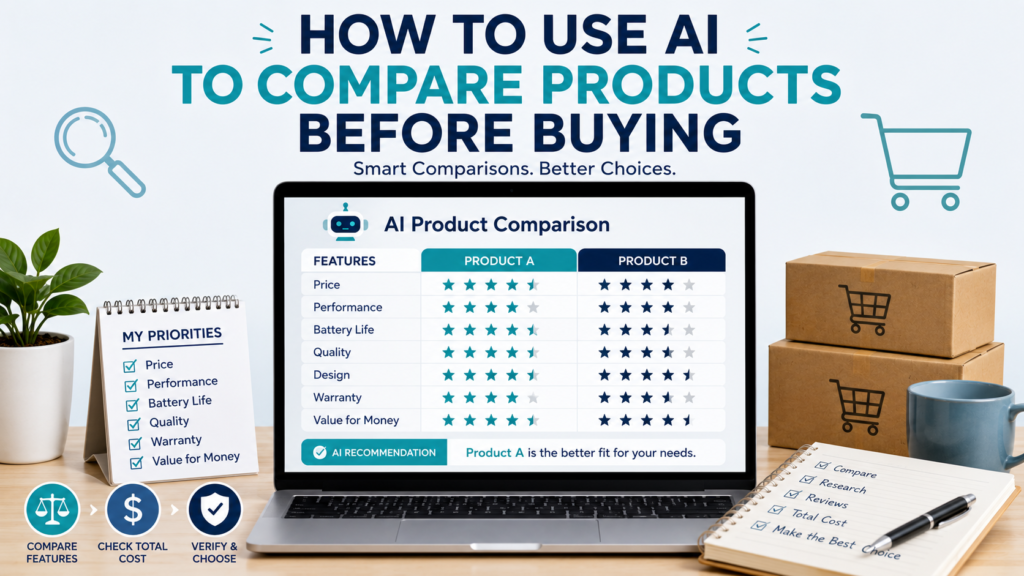
One practical solution is to use AI to compare products before buying. Instead of switching between dozens of product pages and trying to remember every specification, you can ask an AI assistant to organize the differences, compare features, identify trade-offs, and focus on the factors that matter most to you.
However, AI should help you organize your decision—not make the purchase decision for you. Product specifications, prices, availability, warranties, and promotions can change, and AI may sometimes provide outdated or incorrect information.
The best approach is to use AI for comparison and reasoning, then verify important purchasing information from current sources before spending your money.
If you are still researching what products to consider in the first place, start with our guide on How to Use AI to Research a Product Before You Buy. Once you have narrowed your choices, use the comparison process below.
Why Use AI to Compare Products Before Buying?
Product comparisons often become difficult because manufacturers emphasize different features.
One laptop might advertise battery life while another focuses on processing power. One coffee maker may highlight convenience while another emphasizes customization.
AI can help place the information into the same structure.
For example:
Compare Product A and Product B for someone who mainly needs a laptop for web browsing, email, video calls, Microsoft Office, and occasional photo editing. Focus on performance, battery life, screen, weight, ports, warranty, and value.
Instead of receiving a general description of both products, you are telling AI exactly what matters to you.
This is an important distinction.
You are not asking:
Which one is better?
You are asking:
Which one better matches my needs, and why?
Step 1: Define What You Actually Need
Before comparing products, decide what problem you are trying to solve.
Suppose you want a new vacuum cleaner.
Your priorities might include:
- Hardwood floors
- Carpet
- Pet hair
- Stairs
- Lightweight design
- Cordless operation
- Battery life
- Easy maintenance
- Budget
Tell AI:
I need a vacuum for a two-story home with hardwood floors, area rugs, and a dog that sheds. I want something lightweight and easy to carry upstairs. My budget is about $400.
Now AI has a basis for evaluating products.
Without this context, it may focus on features that are impressive but irrelevant to you.
The FTC similarly advises consumers to decide which features are “must-have” versus merely nice to have before comparing products.
Step 2: Identify Your Must-Have Features
Separate requirements from preferences.
For example:
Must Have
- Under $400
- Works well with pet hair
- Suitable for hardwood floors
- Easy to carry upstairs
Nice to Have
- Extra attachments
- Charging dock
- Automatic power adjustment
- Special display
Then ask:
Compare these two products using my must-have features first. Treat the other features as secondary benefits.
This prevents an attractive extra feature from distracting you from the reasons you are buying the product.
Step 3: Give AI the Exact Products
Product names can be surprisingly confusing.
A manufacturer may sell several versions with similar names, and different model years may have different specifications.
Whenever possible, provide:
- Full product name
- Model number
- Version or generation
- Relevant specifications
- Links or copied product information when appropriate
For example:
I am comparing these two exact laptop models. I will provide their specifications below. Compare only the information I provide first.
Then paste the relevant information.
This is often safer than assuming AI already knows the exact current specifications.
Step 4: Ask AI to Create a Comparison Table
Comparison tables make differences easier to see.
Try:
Create a simple comparison table for these two products. Include price, main features, dimensions, weight, warranty, important limitations, and the features most relevant to my needs.
A table might contain:
| Feature | Product A | Product B |
|---|---|---|
| Price | — | — |
| Weight | — | — |
| Battery | — | — |
| Warranty | — | — |
| Best advantage | — | — |
| Main limitation | — | — |
Then check the information against current product sources.
A clean table can reveal differences that are difficult to notice when reading two long product descriptions separately.
Weak Prompt vs. Better Prompt
Weak Prompt
Which laptop should I buy?
This gives AI very little useful context.
It does not know your budget, intended use, preferred screen size, portability needs, or which products you are considering.
Better Prompt
Compare Laptop A and Laptop B for someone who mainly uses web browsing, email, video calls, Microsoft Office, streaming, and light photo editing. My budget is $1,000. Battery life and portability matter more to me than gaming performance. Compare the processor, memory, storage, screen, battery, weight, ports, warranty, and overall value. Explain the biggest trade-off between the two.
The second prompt tells AI how to evaluate the products.
If you want to improve comparison requests like this, How to Write AI Prompts: A Simple Beginner’s Guide explains how to provide clearer instructions and relevant context.
Step 5: Ask AI to Explain the Differences in Plain English
Specifications are not always meaningful to beginners.
Imagine two products list different processors, display technologies, or battery capacities.
Instead of asking only which number is larger, ask:
Explain the practical difference between these specifications in simple language. Tell me when I would actually notice the difference in everyday use.
Or:
Which differences are meaningful for my needs, and which are unlikely to matter much?
This can prevent you from paying extra for specifications that provide little practical benefit for your situation.
Step 6: Compare Strengths and Weaknesses
Ask AI to identify trade-offs rather than simply declare a winner.
For example:
Give me the three biggest advantages and three biggest disadvantages of each product based on my priorities.
A useful comparison might reveal:
Product A
- Lower price
- Lighter
- Better battery life
- Less storage
- Fewer ports
Product B
- Faster performance
- More storage
- Better display
- Heavier
- More expensive
Neither product has to be universally better.
The question is which set of trade-offs fits you better.
Step 7: Create a Weighted Comparison
Some features matter more than others.
Suppose your priorities are:
- Price — 30%
- Battery life — 25%
- Portability — 20%
- Performance — 15%
- Display — 10%
Ask AI:
Create a weighted comparison using these priorities. Explain how you scored each category and do not hide uncertainty when the available information is incomplete.
The result can help organize your thinking.
However, do not treat an AI-generated score such as 8.7/10 as an objective fact.
The weighting comes from your priorities, and the individual scores may involve judgment.
Use the score as a decision aid, not scientific proof that one product is better.
Step 8: Compare the Total Cost, Not Just the Price
The lowest advertised price is not always the lowest total cost.
Consider:
- Shipping
- Taxes
- Required accessories
- Replacement filters
- Ink or toner
- Subscription fees
- Batteries
- Installation
- Maintenance
- Extended service plans
Tell AI:
Compare the likely ownership costs beyond the purchase price. Separate required costs from optional costs.
The FTC’s online shopping guidance recommends comparing the total cost of a purchase, including shipping, handling, delivery, taxes, and other fees—not merely the advertised price.
Step 9: Verify Current Prices Yourself
Price is especially time-sensitive.
A product that costs $399 today might cost $329 during a sale or $449 at another retailer.
If AI tells you a current price, treat it as information that needs verification.
Ask:
Do not assume the prices in this comparison are current. Mark any price information that I should verify before buying.
Then check the actual seller or manufacturer.
The same principle applies to:
- Availability
- Discounts
- Bundles
- Shipping
- Promotions
- Trade-in values
Use AI to organize price information, but use current sources for the final purchasing decision.
Step 10: Verify Important Specifications
AI can confidently state an incorrect specification.
That is especially risky when products have similar names or several generations.
Before buying, verify the specifications that affect your decision.
For example:
- Size
- Weight
- Compatibility
- Battery specifications
- Storage
- Included accessories
- Ports
- Warranty
- Model number
If AI says Product A weighs 3.1 pounds but weight is an important reason you prefer it, check the manufacturer’s current specifications before purchasing.
This is where How to Check If an AI Answer Is Accurate becomes particularly useful. Important AI-generated claims should be verified rather than accepted because they sound confident.
Step 11: Use Reviews Carefully
Customer reviews can reveal problems that specifications cannot.
For example, reviews may discuss:
- Reliability
- Comfort
- Noise
- Ease of use
- Real-world battery life
- Customer support
- Durability
But reviews also have limitations.
Some may be fake, manipulated, incentivized, outdated, or based on unrealistic expectations.
The FTC recommends checking reviews from a variety of sources and not relying on star ratings alone. It also advises considering where a review was posted, who wrote it, and whether incentives may have influenced it.
Instead of asking AI:
What do reviews say?
try:
Summarize recurring positive and negative themes from the review information I provide. Separate repeated patterns from isolated complaints.
This is a much more useful task.
Step 12: Separate Facts From Opinions
Ask AI:
Separate this comparison into verified specifications, reviewer opinions, and your interpretation.
This can help distinguish:
Fact: Product A weighs 4.2 pounds.
Review opinion: Several reviewers describe Product A as heavy.
Interpretation: Product A may be less convenient for someone who frequently carries it upstairs.
Those are three different types of information.
Keeping them separate makes the comparison easier to evaluate.
Step 13: Ask What Information Is Missing
One of the best comparison prompts is:
What important information is missing that I should verify before choosing between these products?
AI might identify:
- Warranty differences
- Compatibility
- Return policy
- Replacement costs
- Included accessories
- Product dimensions
This turns AI from an answer generator into a checklist assistant.
Step 14: Check Return and Warranty Terms
A product comparison should not stop at specifications.
Imagine two products are almost identical, but one seller offers a 30-day return period while another charges a restocking fee.
That difference may affect your decision.
Before buying, check:
- Return window
- Return shipping
- Restocking fees
- Manufacturer warranty
- Seller warranty
- Exclusions
FTC consumer guidance specifically recommends reviewing delivery, return, and refund policies before purchasing online.
Ask AI:
Add return policy and warranty to my final comparison, but mark anything that needs current verification.
Step 15: Ask AI Who Each Product Is Best For
Instead of demanding one winner, try:
Based on this comparison, describe the type of buyer who would be better suited to Product A and the type of buyer who would be better suited to Product B.
You might get something like:
Product A may fit buyers who prioritize portability and price.
Product B may fit buyers who prioritize performance and storage.
This framing is often more useful than a generic “Product B wins.”
Step 16: Ask for a Recommendation Based on Your Priorities
After completing the comparison, you can ask for a recommendation.
For example:
Based only on the information we verified and the priorities I gave you, which product appears to fit my needs better? Explain the three strongest reasons and mention the biggest downside of your recommendation.
Notice the wording.
You are asking AI to reason from the information you supplied rather than pretending it has perfect knowledge of every product.
A Reusable AI Product Comparison Prompt
Use this template when comparing products:
Help me compare two products before buying.
Product A:
[Exact product/model]Product B:
[Exact product/model]My main use:
[Explain what you need the product for]Budget:
[Amount]Must-have features:
[List]Nice-to-have features:
[List]Most important priorities:
[Price, performance, durability, portability, etc.]Compare the products in a table. Then explain the most important practical differences, strengths, weaknesses, and trade-offs. Separate verified specifications from opinions or assumptions. Clearly mark prices, availability, warranty terms, and other information that may need current verification. Finally, explain which product appears to fit my priorities better and why.
You can adapt the template for laptops, appliances, headphones, kitchen equipment, tools, or many other everyday products.
Practical Example: Comparing Two Vacuum Cleaners
Imagine you are comparing two cordless vacuums.
Your priorities are:
- Pet hair
- Hardwood floors
- Area rugs
- Lightweight design
- Stairs
- Under $400
Start with:
Compare Vacuum A and Vacuum B for a two-story home with hardwood floors, area rugs, and a shedding dog. My budget is $400. Weight and pet-hair performance matter more than extra accessories. Create a comparison table and identify any specifications that I should verify.
Then:
Explain the biggest practical difference between them in plain English.
Next:
Which model appears better for frequently carrying upstairs?
Then:
What are the three most important things I should verify on the manufacturer or retailer websites before buying?
Finally:
Based on the verified information, explain which one better matches my priorities. Include one reason I might still choose the other model.
That final question helps reduce one-sided reasoning.
Common Mistakes When Using AI for Product Comparisons
Asking “Which Is Better?” Without Context
Better for whom?
Define your needs first.
Comparing Similar Product Names Without Model Numbers
Make sure you are comparing the exact versions you intend to buy.
Trusting AI’s Current Price
Prices change frequently.
Verify them before purchasing.
Focusing Only on Specifications
Real-world usability, warranty, maintenance, and total cost can matter just as much.
Treating Reviews as Facts
Reviews reflect individual experiences and can sometimes be misleading or manipulated.
Look for recurring patterns across multiple sources.
Letting AI Choose Your Priorities
AI can organize priorities, but you should decide what matters most to you.
Assuming the Most Expensive Product Is Best
Extra features only have value when they are useful to you.
Protect Your Personal Information
You usually do not need to provide sensitive personal information to compare products.
For example, AI may need to know:
My budget is about $800.
It does not need:
- Your credit card information
- Bank account details
- Exact financial balances
- Account passwords
- Home address
- Retailer login information
Give AI the context necessary for the comparison and nothing more.
Use AI as a Comparison Assistant
AI is especially useful for taking a large amount of product information and organizing it around your priorities.
It can help you:
- Build comparison tables
- Explain technical specifications
- Identify trade-offs
- Compare pros and cons
- Apply your priorities
- Identify missing information
- Organize review themes
- Compare ownership costs
- Create a final verification checklist
But it should not replace current product information.
Specifications change. Prices change. Promotions expire. Product versions change. Retailer policies change.
The closer you get to clicking “Buy,” the more important verification becomes.
Final Takeaway
Learning how to use AI to compare products before buying can make complicated purchasing decisions easier to understand.
Start by defining what you actually need and separating must-have features from nice-to-have extras. Give AI the exact products you are comparing and ask it to organize the differences into a clear table.
Then go deeper.
Ask about practical differences, strengths and weaknesses, total ownership costs, review patterns, missing information, and the trade-offs that matter most to you.
Most importantly, verify current prices, specifications, warranties, availability, and return policies before purchasing.
AI can help you understand the decision. You should still make the final decision using current, verified information.