
Introduction
AI can answer questions, explain complicated topics, write emails, summarize documents, and help with everyday decisions. Because its answers often sound clear and confident, it is easy to assume that they are correct.
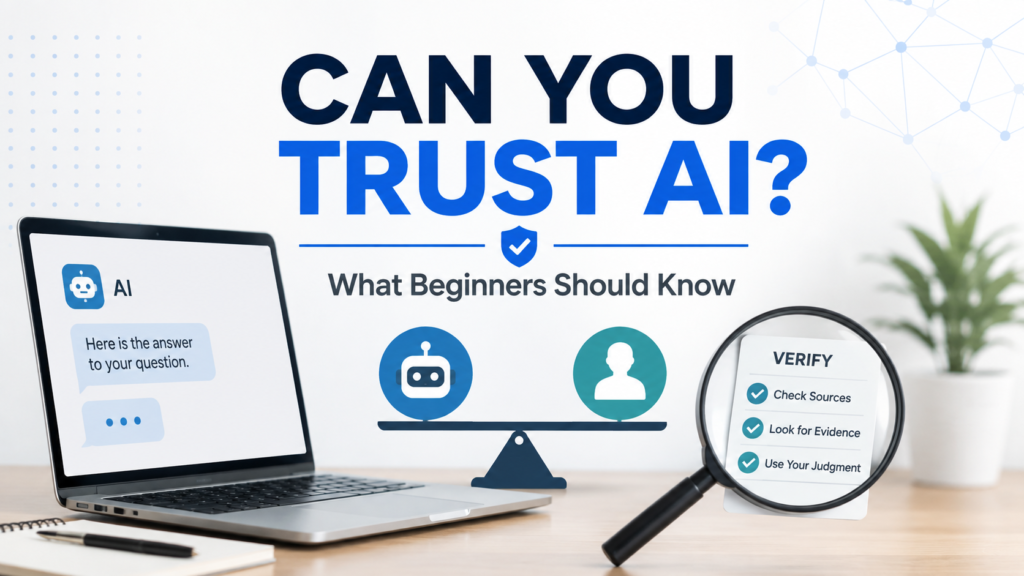
But can you trust AI?
The best answer for beginners is: AI can be very useful, but you should not trust every answer automatically.
AI does not understand truth in the same way a person does. It generates responses based on patterns learned from large amounts of information. Sometimes the result is accurate and helpful. Other times, AI can misunderstand your question, provide outdated information, or confidently give you something that is simply wrong.
Learning when to trust AI—and when to verify it—is one of the most important skills for using AI responsibly.
Why AI Can Seem So Trustworthy
Modern AI systems are designed to communicate naturally.
They can explain ideas in simple language, organize answers into clear steps, and respond confidently to follow-up questions.
That makes AI convenient.
It can also create a problem.
A well-written answer can feel trustworthy even when the information behind it is inaccurate.
For example, an AI response might include a specific date, statistic, study, or quotation. The details can make the answer look authoritative.
But presentation and accuracy are two different things.
You should judge important AI answers by the quality of the evidence supporting them—not simply by how professional they sound.
AI Can Give Correct Answers
It is important not to go too far in the opposite direction.
AI is not always unreliable.
It can be extremely useful for many everyday tasks, including:
- Brainstorming ideas
- Improving writing
- Explaining basic concepts
- Organizing information
- Creating checklists
- Comparing general options
- Generating questions
- Summarizing information you provide
For these kinds of tasks, you may not need to verify every sentence.
If you ask AI to suggest ten dinner themes for a family gathering, for example, there is little reason to fact-check every idea.
The amount of verification you need should depend on what you plan to do with the answer.
AI Can Also Be Confidently Wrong
One of the biggest mistakes beginners make is assuming that confidence means accuracy.
AI can produce incorrect information while presenting it in a polished and convincing way.
These errors can include:
- Incorrect dates
- Made-up statistics
- Misidentified people or organizations
- Outdated information
- Incorrect explanations
- Nonexistent studies
- Fabricated citations
This behavior is commonly associated with AI hallucinations.
The important lesson is simple:
A confident AI answer is not automatically a verified AI answer.
Why Does AI Make Mistakes?
AI systems such as large language models generate responses by predicting useful patterns in language.
They are not simply searching through a perfect database of verified facts every time you ask a question.
If you want to understand this distinction more clearly, learning what large language models are can help explain why an AI system can produce fluent language without guaranteeing that every statement is correct.
Several things can contribute to an inaccurate response.
Your question may be unclear.
The AI may lack current information.
The available information may be incomplete.
The subject itself may be complicated or disputed.
Or the model may generate a plausible answer even when it does not have enough reliable information.
Trust AI Differently Depending on the Task
A useful approach is to think about the consequences of an incorrect answer.
Low-Risk Tasks
You can generally be more relaxed when using AI for:
- Brainstorming
- Meal ideas
- Writing inspiration
- General organization
- Practice questions
- Creative projects
A mistake in these situations is usually easy to notice or correct.
Medium-Risk Tasks
Use more caution with:
- Product comparisons
- Travel planning
- Technical instructions
- Educational research
- Workplace information
Check important details before acting.
High-Risk Tasks
Be especially careful with:
- Medical information
- Legal matters
- Financial decisions
- Taxes
- Personal safety
- Major contracts
- Important professional decisions
AI may help explain terminology or prepare questions, but important decisions should not depend solely on an AI response.
Check Important Claims Before You Trust Them
When an AI answer matters, verification should become part of the process.
Learning how to check if an AI answer is accurate gives you a simple framework for doing this.
Start by identifying the claims that actually matter.
Then look for evidence from reliable sources.
For example, if AI tells you that a government rule changed recently, check the relevant government website.
If it describes a feature of a software product, check the company’s official documentation.
If it mentions research, look for the original study or institution.
You usually do not need to verify every word.
Verify the information that could change your decision.
Ask AI Where the Information Came From
You can also ask AI to help you identify sources.
For example:
“Give me the primary sources supporting the three most important claims in your answer.”
Or:
“Provide official sources I can use to verify this information.”
This can make research faster.
However, asking for sources is only the first step.
You still need to open and examine them.
Learning how to ask AI for reliable sources is useful because AI-generated citations should not automatically be treated as proof.
Check that the source exists and actually supports the statement.
Prefer Primary and Authoritative Sources
Not every website deserves equal trust.
For important factual information, try to get as close to the original source as possible.
Depending on the topic, reliable sources may include:
- Government agencies
- Universities
- Original research
- Official organizations
- Official product documentation
- Established professional institutions
For example, the U.S. National Institute of Standards and Technology explains that trustworthy AI involves characteristics such as reliability, safety, security, transparency, privacy, and fairness.
That broader idea is useful for beginners: trust in AI is not simply a yes-or-no question. It depends on the system, the situation, and how the information is being used.
Watch for Outdated Information
An AI answer may have been reasonable at one point and still be wrong today.
This is especially important for topics that change frequently, such as:
- Prices
- Laws and regulations
- Software features
- Travel requirements
- Product specifications
- Current events
- Company policies
If the information is time-sensitive, ask for the date and verify the current information yourself.
For example:
“What is the current information as of August 2026? Please provide an official source.”
Even then, open the source and confirm it.
Be Specific About What You Want
Sometimes an unreliable-looking answer begins with an unclear question.
Compare:
“What is the best computer?”
with:
“I need a laptop under $800 for web browsing, email, video calls, and basic photo editing. What specifications should I prioritize?”
The second question gives AI useful context.
Learning how to ask AI better questions can improve the relevance of AI responses, although a better prompt still does not guarantee factual accuracy.
Good prompting improves the conversation.
Verification establishes trust.
Do Not Confuse AI With a Human Expert
AI can explain difficult information in a remarkably accessible way.
That does not mean it has professional judgment, personal experience, or responsibility for the consequences of its recommendations.
A useful way to think about AI is:
AI can help you prepare for an important conversation.
It should not necessarily replace that conversation.
For example, AI might help you create questions to ask an accountant, doctor, attorney, teacher, mechanic, or financial professional.
That can make AI extremely valuable without requiring you to treat it as the final authority.
Protect Your Information While Checking Answers
Trust is not only about whether an answer is factually correct.
It is also about how you use the technology.
Avoid sharing unnecessary sensitive information while asking questions or requesting verification.
Knowing how to protect your privacy when using AI helps you get useful assistance without providing personal details the AI does not need.
Accuracy and privacy are different issues, but both are part of responsible AI use.
A Simple Rule for Beginners
You do not need to distrust everything AI says.
You also should not believe everything AI says.
Instead, use this simple rule:
The greater the consequence of being wrong, the more carefully you should verify the AI answer.
If AI suggests a movie and gets something wrong, the consequence is small.
If AI provides information that could affect your health, finances, legal rights, job, or safety, the consequence may be much greater.
Your level of verification should increase accordingly.
A Quick Trust Checklist
Before relying on an important AI answer, ask:
Does this answer contain factual claims that matter?
Is the information current?
Can I verify it through an authoritative source?
Does the cited source actually support the claim?
Would a mistake cause a meaningful problem?
Should a qualified professional review this information?
If several of these questions matter, do not rely on the AI answer alone.
Final Thoughts
So, can you trust AI?
Yes—but not blindly.
AI can be a powerful assistant for learning, writing, organizing ideas, exploring options, and solving everyday problems.
The safest approach is not complete trust or complete distrust.
It is informed trust.
Understand that AI can make mistakes. Verify important claims. Prefer authoritative sources. Protect your private information. And keep human judgment involved when the consequences matter.
Once you develop these habits, you can take advantage of what AI does well without assuming that every confident answer is correct.