
Introduction
AI can write emails, summarize documents, explain complicated ideas, generate images, organize information, and help with many everyday tasks.
But AI has limits.
Understanding the limitations of AI is just as important as learning what AI can do. Beginners sometimes assume that because an AI tool can produce impressive answers quickly, it must understand everything or always know the correct answer.
It does not.
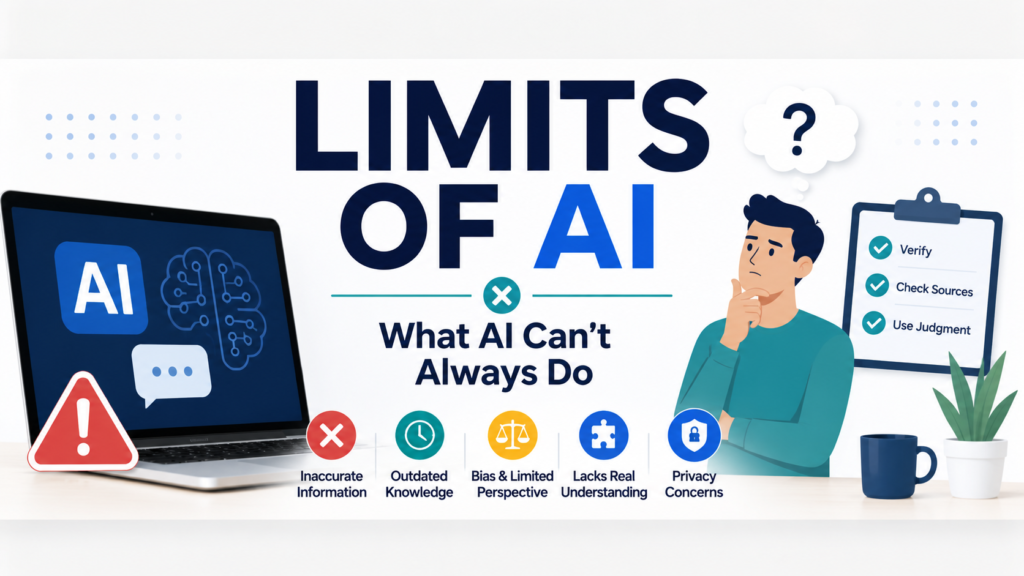
AI can make mistakes, lack current information, misunderstand context, produce biased or incomplete responses, and sometimes generate information that sounds convincing but is not true.
Knowing these limitations does not make AI less useful. It helps you use AI more effectively and know when human judgment or additional verification is necessary.
1. AI Can Give Incorrect Information
One of the most important limitations of AI is that its answers are not guaranteed to be correct.
An AI response may contain:
- Incorrect facts
- Wrong dates
- Inaccurate statistics
- Misleading explanations
- Outdated information
- Unsupported claims
The difficult part is that an incorrect answer may still sound confident and professional.
That is why you should not judge an AI answer only by how convincing it sounds.
For important information, check if an AI answer is accurate before relying on it.
2. AI Can Hallucinate
Sometimes AI generates information that appears reasonable but is inaccurate or completely fabricated.
This is often called an AI hallucination.
For example, AI might provide a quotation that was never said, describe a study that does not exist, or create a citation that looks legitimate but leads nowhere.
Beginners should understand that AI is capable of generating plausible language even when it does not have reliable evidence for what it is saying.
This is especially important when using AI for research or factual questions.
3. AI Does Not Always Have Current Information
Some AI tools can access current web information, while others may rely primarily on information learned during training or information provided in the conversation.
Even AI systems with web access can miss recent changes or retrieve incomplete information.
This matters for topics that change frequently, such as:
- Prices
- News
- Laws
- Travel requirements
- Product features
- Software instructions
- Company policies
- Government programs
If the date matters, ask AI for current information and then verify the answer using an authoritative source.
Never assume that an AI response is current simply because it sounds specific.
4. AI Can Misunderstand Your Question
AI works with the information you provide.
If your question is vague, incomplete, or ambiguous, the answer may not match what you actually need.
For example:
“What should I buy?”
does not give AI much useful context.
A better question might be:
“I need a lightweight laptop under $800 for email, web browsing, video calls, and basic photo editing. What specifications should I prioritize?”
Learning how to ask AI better questions can improve the relevance of AI responses.
However, even an excellent prompt cannot guarantee that every fact in the answer will be correct.
5. AI Does Not Think Like a Human
AI can produce language that feels surprisingly human.
But that does not mean it thinks, understands, experiences emotions, or uses judgment exactly as a person does.
For example, an AI system can explain what grief means or write a compassionate message, but it does not experience grief itself.
Similarly, it can describe ethical considerations without having personal values or life experiences.
This distinction matters because fluent conversation can make it easy to give AI more authority than it deserves.
AI is a powerful tool, but human judgment remains important.
6. AI May Miss Important Context
Sometimes a question cannot be answered well without understanding the larger situation.
Imagine asking AI:
“Should I accept this job?”
A useful answer could depend on your finances, family responsibilities, career goals, workplace culture, commute, benefits, health needs, and many other factors.
AI only knows the context you provide.
Even when you provide extensive information, it may not understand the situation with the depth that you do.
AI can help you identify factors to consider, but it should not automatically make major life decisions for you.
7. AI Can Reflect Biases
AI systems learn patterns from large amounts of data.
That data can contain biases, stereotypes, incomplete perspectives, and historical inequalities.
As a result, AI responses can sometimes reflect those problems.
Bias can be obvious, but it can also be subtle.
For important questions involving people, culture, employment, education, or other sensitive decisions, consider whether the response represents only one perspective.
You can ask AI:
“What assumptions might be influencing this answer?”
or:
“Give me several reasonable perspectives on this issue.”
These prompts do not eliminate bias, but they can encourage broader thinking.
8. AI Does Not Automatically Know What Sources Are Reliable
An AI system may mention websites, studies, reports, or organizations.
That does not automatically mean those sources are trustworthy—or even that a cited source exists exactly as described.
When factual accuracy matters, learning how to ask AI for reliable sources can improve your research process.
But asking for a source is not enough.
Open the source yourself and check:
- Who published it?
- When was it published?
- Is it the original source?
- Does it actually support the AI’s claim?
- Is newer information available?
Verification remains your responsibility.
9. AI Cannot Replace Professional Judgment in Every Situation
AI can be helpful when learning about medical, financial, legal, or other specialized subjects.
For example, you might use AI to explain terminology or create a list of questions to ask a professional.
But high-stakes decisions often require expertise, personal context, professional responsibility, and current information.
AI should not automatically replace a qualified professional when those factors matter.
A useful approach is to ask:
“Explain this concept in simple language and give me questions I should ask a qualified professional.”
That uses AI as an educational assistant rather than the final decision-maker.
10. AI Only Knows What You Tell It About Your Situation
AI does not automatically know your complete circumstances.
Suppose you ask:
“Create the best weekly schedule for me.”
Without additional information, AI does not know your work hours, family responsibilities, priorities, energy levels, appointments, or preferred routines.
Providing relevant context can improve the result.
But remember that good context does not require exposing unnecessary personal information.
Knowing how to protect your privacy when using AI helps you balance useful context with responsible information sharing.
11. AI May Produce Generic Answers
Sometimes AI responses are technically correct but not especially useful.
You may receive broad advice such as:
“Stay organized.”
“Set clear goals.”
“Research your options.”
These suggestions are not necessarily wrong, but they may not solve your actual problem.
Follow-up questions can improve the result.
For example:
“Turn that advice into five specific actions I can complete this week.”
or:
“Give me an example for someone who has never done this before.”
AI often becomes more useful when you treat the first answer as the beginning of a conversation rather than the final result.
12. AI Can Make Mistakes With Numbers and Logic
AI can perform many calculations and reasoning tasks, but you should not assume that every numerical result is correct.
It may make mistakes when:
- Performing calculations
- Comparing quantities
- Interpreting complicated tables
- Following multi-step logic
- Working with incomplete data
For important calculations, use a calculator, spreadsheet, specialized software, or another reliable method to verify the result.
Ask AI to explain its reasoning if that helps you identify assumptions, but do not treat the explanation itself as proof of accuracy.
13. AI Cannot Guarantee Privacy
Another limitation is that users do not have identical privacy protections across every AI service.
Different providers may have different policies for storing conversations, using data, retaining information, and offering privacy controls.
Before sharing information with an AI service, understand its privacy options and avoid providing sensitive information that is unnecessary for the task.
A good rule is simple:
If AI does not need the information, do not provide it.
14. AI Cannot Take Responsibility for Your Decisions
AI can provide suggestions.
It can compare options.
It can explain possible advantages and disadvantages.
But ultimately, you are responsible for what you do with the information.
If AI recommends a product, you decide whether to buy it.
If AI suggests a travel itinerary, you verify reservations, schedules, and requirements.
If AI drafts an important email, you review it before sending.
This is one reason using AI safely involves keeping human judgment in the process.
What AI Is Actually Good At
Understanding limitations should not make you afraid to use AI.
AI is particularly useful when you treat it as an assistant.
It can help you:
- Generate ideas
- Organize thoughts
- Simplify complicated explanations
- Draft and revise writing
- Create checklists
- Explore alternatives
- Prepare questions
- Summarize information
- Learn unfamiliar concepts
The key is matching the tool to the task.
Use AI where it adds value, and add verification or human expertise where the consequences of an error are significant.
A Simple Rule for Beginners
When using AI, remember:
The more important the decision, the less you should rely on AI alone.
For low-risk tasks, such as brainstorming dinner ideas, verification may not be necessary.
For important factual information, check reliable sources.
For high-stakes decisions, combine AI assistance with authoritative information and qualified human judgment when appropriate.
This simple habit allows you to benefit from AI without expecting it to do things it cannot reliably do.
Final Thoughts
AI is powerful, but it is not perfect.
It can make factual mistakes, misunderstand context, reflect biases, provide outdated information, generate false citations, and overlook important details.
Understanding the limitations of AI helps you become a better AI user.
Instead of asking, “Can AI do this?” also ask:
“How much should I rely on the answer?”
That small change in thinking can help you use AI with greater confidence, better judgment, and fewer unnecessary mistakes.