
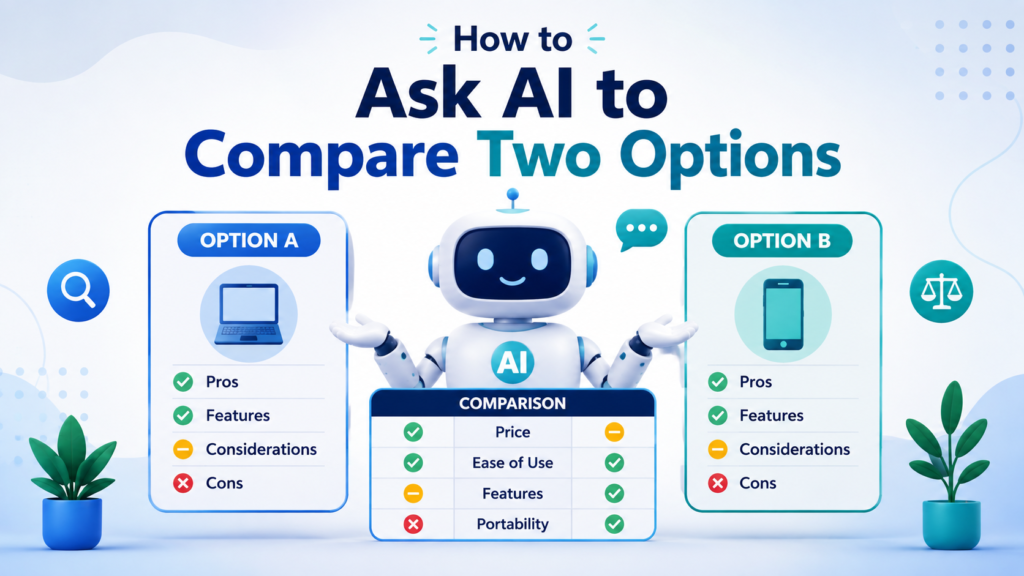
Choosing between two options can be difficult. Maybe you are comparing two products, deciding between two travel plans, choosing a software tool, or trying to figure out which option better fits your needs.
AI can help you organize the differences and think through your choices. But the quality of the comparison depends heavily on what you ask.
Learning how to ask AI to compare two options can help you get a clearer, more useful comparison instead of a vague answer that simply tells you one choice is “better.”
In this guide, you’ll learn a simple way to compare two options with AI, along with practical prompts you can copy and use.
Why Use AI to Compare Two Options?
When you compare two choices on your own, it is easy to focus on only one or two obvious differences.
Learning how to ask AI to compare two options can help you organize important information into categories such as:
- Price
- Features
- Advantages
- Disadvantages
- Ease of use
- Time required
- Convenience
- Your specific priorities
The goal is not to let AI make every decision for you.
Instead, use AI as a tool to organize information, identify questions you may not have considered, and make the differences easier to understand.
You still make the final decision.
How to Ask AI to Compare Two Options Effectively
A simple prompt might be:
Compare Option A and Option B.
AI can respond to that request, but it does not know what matters most to you.
A more useful prompt includes four things:
The two options + your goal + your priorities + the desired format
For example:
Compare Option A and Option B for someone who wants an affordable and easy-to-use solution. Compare price, ease of use, important features, advantages, and disadvantages. Put the results in a simple table and explain which option may be better for different types of users.
Now AI has much more information about the comparison you actually want.
Weak Prompt vs. Better Prompt
Here is a simple example.
Weak Prompt
Which laptop is better, Laptop A or Laptop B?
The word “better” is too broad.
Better for what?
Price? Battery life? Travel? Gaming? Everyday use?
Better Prompt
Compare Laptop A and Laptop B for a beginner who mainly needs a computer for email, web browsing, video calls, and basic documents. Compare price, ease of use, battery life, portability, and important features. Show the comparison in a table. Do not choose a winner until you explain the advantages and disadvantages of both.
This prompt gives AI a specific job.
It also helps reduce the chance of receiving a generic recommendation that does not match your needs.
Tell AI What Matters Most to You
One of the most useful things you can add to a comparison prompt is your personal priority.
Imagine two products cost $100 and $150.
The cheaper product may seem like the obvious choice. But if durability is more important than price, the comparison could look very different.
You might say:
Compare these two options, but give extra importance to ease of use and reliability. Price is important, but it is not my highest priority.
Or:
Compare these two options for me. My priorities, in order, are price, ease of use, and customer support.
This tells AI how to evaluate the information instead of treating every factor as equally important.
Ask AI to Use a Comparison Table
Tables are especially useful when comparing two choices.
Try:
Compare these two options in a table. Use the following categories: price, main features, advantages, disadvantages, ease of use, and best for.
A table makes it easier to scan the differences without reading several long paragraphs.
After the table, you can ask:
Based on the comparison, explain the three biggest differences in simple language.
This combines a quick visual comparison with a more useful explanation.
Practical Prompts for Comparing Two Options
Here are several prompts you can adapt to everyday situations.
1. Compare Two Products
Compare [Product A] and [Product B]. Focus on price, important features, ease of use, durability, advantages, and disadvantages. Put the information in a table. Then explain which type of buyer each product may be better for.
2. Compare Two AI Tools
Compare [AI Tool A] and [AI Tool B] for a beginner. Focus on ease of use, major features, free versus paid options, learning curve, and the types of tasks each tool handles well. Explain the differences in simple language.
3. Compare Two Travel Options
Compare traveling by [Option A] versus [Option B] for this trip. Consider total cost, travel time, convenience, flexibility, and possible disadvantages. Show the comparison in a table and tell me what additional information I should check before deciding.
4. Compare Two Plans or Services
Compare these two plans using only the information I provide. Identify the important differences in price, included features, limitations, and possible extra costs. If information is missing, clearly tell me instead of guessing.
5. Compare Two Choices Based on Your Priorities
Help me compare [Option A] and [Option B]. My three most important priorities are [Priority 1], [Priority 2], and [Priority 3]. Compare both options based on those priorities and explain the trade-offs. Do not make the final decision for me.
That final sentence is useful when you want AI to help you think rather than simply select a winner.
Ask AI to Explain the Trade-Offs
A good comparison should not always produce an obvious winner.
Often, one option is stronger in one area and weaker in another.
For example:
- Option A may be cheaper but have fewer features.
- Option B may cost more but save time.
- Option A may be easier for beginners.
- Option B may offer more advanced capabilities.
These are trade-offs.
Try asking:
What are the biggest trade-offs between these two options?
Then follow with:
What would I gain and what would I give up by choosing Option A instead of Option B?
This can be more useful than asking AI, “Which one is better?”
Ask AI to Separate Facts From Judgment
AI comparisons may include both factual information and interpretations.
You can make that distinction clearer with a prompt such as:
Separate the comparison into two sections: “Facts Provided” and “Interpretation.” Do not present an assumption as a confirmed fact.
If you are providing the source information yourself, you can also say:
Base the comparison only on the information I provide. If there is not enough information to compare something, write “Not enough information.”
This is especially useful when accuracy matters.
Use Follow-Up Prompts to Improve the Comparison
You do not need to create the perfect prompt on your first attempt.
After receiving the comparison, ask follow-up questions.
For example:
Make the comparison simpler.
What is the biggest difference between the two?
Compare them again with price as the highest priority.
Now compare them with ease of use as the highest priority.
What important factor have I forgotten to consider?
What questions should I answer before choosing?
This is one reason follow-up prompts can improve AI answers. You can refine the comparison as you learn what information matters most.
Ask AI to Help You Create Comparison Criteria
Sometimes the hardest part is not comparing the options. It is knowing what you should compare.
Suppose you want to choose between two services but are not sure which factors matter.
Ask:
I am trying to choose between two [products/services/options]. Before comparing them, give me the 7 most important criteria a beginner should consider.
Then review the criteria.
You can remove anything that does not matter to you and add your own priorities.
Next, say:
Now compare Option A and Option B using those criteria.
This turns AI into a tool for structuring your decision rather than simply giving you an answer.
Be Careful When Comparing Current Information
Some comparisons depend on information that changes frequently.
Examples include:
- Prices
- Subscription plans
- Product availability
- Software features
- Travel schedules
- Promotions
- Policies
AI may not always have the latest information.
If current information matters, verify important details on the original company, manufacturer, government, or service provider website before making a decision.
You can also give AI current information yourself and ask it to compare only what you provided.
For example:
I copied the current details of these two plans from their official websites. Compare only the information below and do not add details from memory.
This can make the task easier to verify.
Do Not Share Sensitive Information Just to Get a Comparison
AI does not need every personal detail to help you compare two options.
Avoid pasting unnecessary sensitive information such as passwords, account numbers, confidential documents, or other private data.
Usually, you can describe your priorities without revealing sensitive details.
For example, instead of sharing detailed financial records, you might simply say:
My budget is under $500.
Give AI the information needed for the task, but avoid sharing information that is not necessary.
Verify Important Facts Before Making a Decision
AI can organize information very well, but that does not mean every fact in an AI-generated comparison is automatically correct.
If the decision involves significant money, travel, contracts, health, legal matters, or another important consequence, verify critical facts using reliable original sources.
This is especially important for:
- Prices
- Dates
- Product specifications
- Fees
- Policies
- Eligibility requirements
- Terms and conditions
Knowing how to check if an AI answer is accurate is an important part of using AI for comparisons.
The more important the decision, the more important verification becomes.
A Reusable Prompt Template
Save this template and customize it whenever you need to compare two choices:
Help me compare [Option A] and [Option B].
My goal: [What I am trying to accomplish]
My priorities: [Priority 1], [Priority 2], [Priority 3]
Compare: [Price, features, convenience, etc.]
Format: Put the comparison in a simple table, followed by the main advantages and disadvantages of each option.
Clearly identify missing information. Do not guess when a fact cannot be confirmed.
Finally, explain the biggest trade-offs and tell me what additional information I should check before making my decision.
You can shorten this template for simple decisions or add more details for complicated ones.
Final Thoughts
Learning how to ask AI to compare two options can make everyday decisions easier to organize and understand.
The key is to avoid asking only, “Which one is better?”
Tell AI what you are comparing, what you want to accomplish, which factors matter most, and how you want the comparison presented.
Then use follow-up questions to explore the trade-offs.
AI can help you organize the decision, but you should still verify important facts and make the final choice yourself.